
Review · PUERTO DEL ROSARIO
4 Hour Surf Lesson
The best feature here is the choice of eight to ten beaches. Instead of taking every class to one fixed stretch of sand, Flag Beach can choose a suitable beach break, or an easy reef break, based on the day’s conditions. That makes this a more sensible first lesson than simply hoping the waves cooperate.
I like the small maximum of eight people, which gives the instructor room to help you catch waves instead of leaving you lost in a crowd. I also like the simple door-to-beach plan: pickup, wetsuit, board, safety briefing, warm-up, then into the water. The main thing to consider is that the beach is not fixed, and driving from the office can take 20 to 25 minutes. Lunch is also your responsibility.
Key points at a glance
- Eight to ten possible beaches: The school can choose mainly beach breaks, with some easy reef breaks available.
- Pickup from your accommodation: Hotel or apartment pickup and return are offered at the same location.
- Small class size: The maximum is eight people, a useful limit for hands-on coaching.
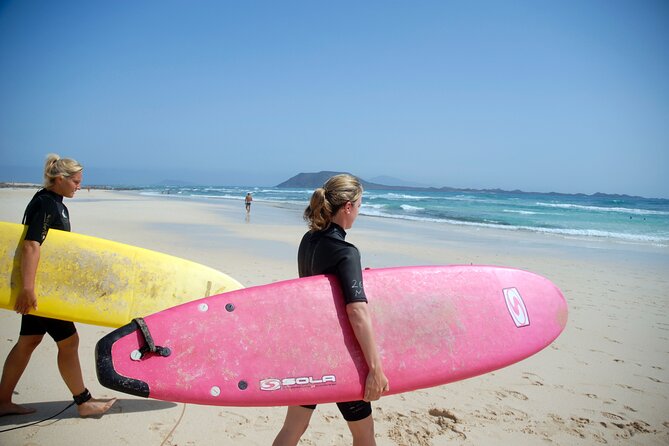
- Equipment included: Your surfboard and wetsuit are provided.
- Friendly named instructors: Alex, Christian, Lorenzo, Igor, and Pawel are praised for clear explanations and patient help.
- Four hours on the schedule: Allow extra time for pickup, signing in, changing, and the drive to the beach.
From Puerto del Rosario to the right beach
This is not a lesson that begins with you carrying a board through town. Flag Beach picks you up at your hotel or apartment, then takes you to its office to sign in and collect a wetsuit. You’ll also receive your surfboard before heading out.
That arrangement matters if you are new to surfing or are traveling without equipment. You do not need to work out which beach has usable waves, find a rental shop, or arrange a taxi with a long board in tow. The return pickup is also described as being to the same accommodation, which keeps the day straightforward.
The advertised duration is about four hours, but the actual time includes more than the class itself. The drive from the office to the teaching beach can take 20 to 25 minutes, depending on where the school is teaching that day. You should allow some flexibility around the stated four-hour period, especially if you have dinner reservations or another activity booked immediately afterward.
The moving beach choice is one of the strongest parts of the setup. Flag Beach has roughly eight to ten beaches available, mainly beach breaks and some easy reef breaks. In plain terms, the school can look for a spot that matches the conditions rather than forcing beginners into poor waves at one location.
More Surf Lessons in Spain:
- Tenerife: Surfing Lesson for All Levels, Photos included
★ 4.9 · 1,314 reviews - Group Surfing Lesson at Playa de las Américas, Tenerife
★ 5.0 · 1,072 reviews - Playa de las Américas: Private or Small-Group Surf Lesson
★ 4.8 · 980 reviews
A safety briefing before your first wave
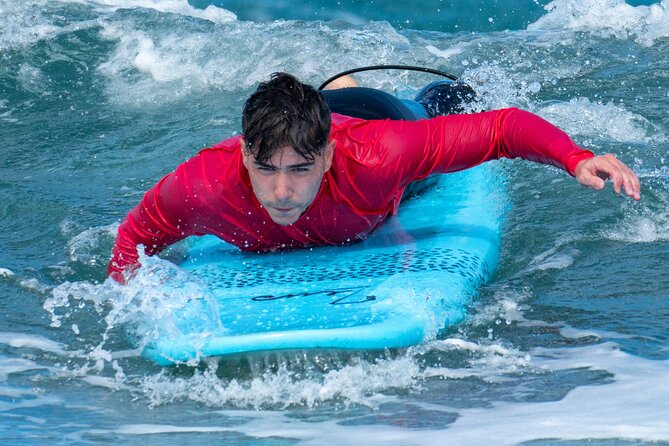
Once you reach the beach, the instructor begins with a safety briefing. This is essential for a first lesson, since surfing is not just about standing on a board. You need to know how to handle the board, where to position yourself, how to avoid other people, and what to do when a wave arrives too quickly.
The briefing is followed by a warm-up. That gives you time to loosen your shoulders and legs before paddling and standing. It also creates a useful pause between the drive and the physical work of the class.
After the warm-up, you collect your board and begin trying to catch waves. The teaching style seems to be practical rather than lecture-heavy. Alex is praised for explaining the steps clearly while keeping the mood relaxed. Pawel helped a 13-year-old student understand the basics and enjoy the session, which suggests the class can work well for older children as well as adults.
You should still keep expectations realistic. Four hours is enough to learn the basic movements and get a feel for surfing, but it does not turn you into an independent surfer in one morning. Some people may stand by the end of the class, while others may need more practice. The useful goal is to learn safe habits, understand the pop-up movement, and catch a few waves with help.
How the small group changes the lesson
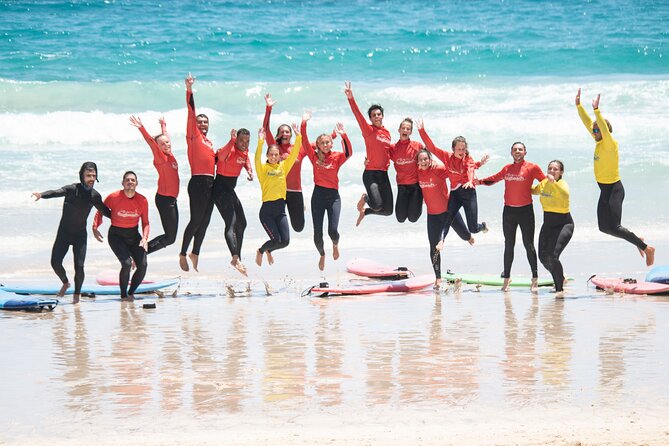
A maximum of eight people is a good middle ground. You get the social feel of a group class without the very large crowd that can make a beginner lesson feel like a queue.
Surf teaching involves a lot of waiting. The instructor needs to watch the water, send people toward suitable waves, and give corrections between attempts. With eight or fewer people, there is at least a reasonable chance of receiving repeated help during the session.
This matters because catching a wave is often the hardest part for a beginner. One person who joined alone described Alex as professional, funny, and good at making the class feel comfortable. The practical benefit is clear: you are more likely to ask questions, try again after falling, and keep going when the first attempts are awkward.
The group limit does not promise private tuition. You will still share the instructor’s attention, and the amount of one-to-one coaching may change with the group’s ability levels. Still, eight is a sensible ceiling for an introductory lesson, especially when the instructor is actively helping people catch waves.
Instructors who teach in different ways
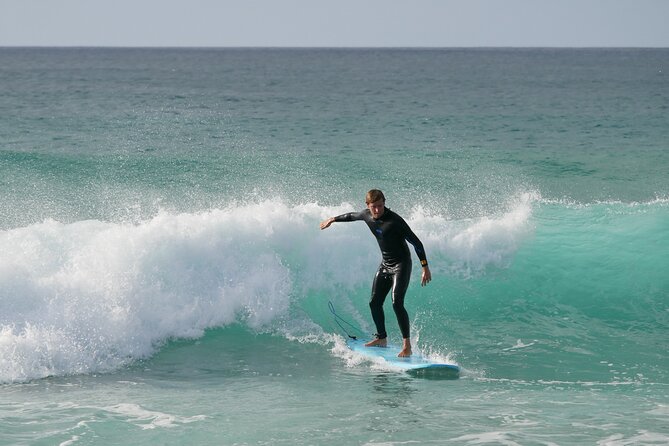
The school uses several instructors, so your exact teaching style may vary. Alex is praised for clear explanations and a good sense of humor. Christian is described as giving useful tips and helping students find suitable surf spots. Lorenzo and Igor have both been praised for their enthusiasm and practical knowledge of water sports.
Pawel receives particular credit for explaining the process well to a younger student. Another instructor, Michal, is praised for watching technique closely and correcting mistakes during windsurfing instruction. That comment comes from a different water sport, so it should not be treated as a direct promise about this surf class, but it does help show the wider teaching approach at Flag Beach.
The instructors do not all teach in exactly the same way. Some may focus on clear step-by-step instruction, while others may give more hands-on help in the water. That variety can be useful, but people who want a very uniform teaching program should know that the individual coach will shape the experience.
The strongest pattern is personal encouragement. The instructors are described as friendly, down to earth, and willing to explain the same movement more than once. For a beginner, that can matter as much as technical detail. A calm coach helps you try again instead of treating a fall as failure.
Same break, a different way into the water:
- From Nerja: Guided Paddle Surf Cliffs and Maro Waterfall
★ 4.5 · 400 reviews - Playa del Inglés Maspalomas: High Quality Surf Classes
★ 4.9 · 363 reviews - Fuerteventura: Surfing Lesson in the south of Fuerteventura
★ 4.8 · 354 reviews - Lezioni di Surf per Beginner e Intermedi (6 persone a istruttore)
★ 5.0 · 350 reviews
What the board and wetsuit provide
The price includes a surfboard and wetsuit. That makes the $66.01 cost easier to judge, since you are paying for instruction, equipment, transportation, and a half-day structure rather than only an hour of coaching.
The wetsuit is especially useful because you may spend a long time in the water while learning. Beginners often fall frequently, so warmth and comfort can affect how much energy you have left for another attempt. You do not need to pack your own surfboard or arrange a separate equipment rental.
The included board also removes a common source of confusion. First-time surfers may not know what board size or shape suits them. The school supplies the equipment as part of the lesson, so the instructor can direct you toward the board intended for the class.
No lunch is included. Bring whatever food or drink you need, or plan to eat after the session. One instructor has been associated with stopping at a cozy coffee bistro for coffee and cake, but that should not be treated as part of this four-hour booking. The formal arrangement includes the board and wetsuit, not a meal.
Beach breaks, reef breaks, and changing conditions
Most lessons take place at beach breaks. These are generally a practical setting for beginners because the shore is made of sand, although conditions can still change and the instructor’s safety guidance matters.
The school also uses some easy reef breaks. That gives the instructors another option when choosing a teaching spot, but you should listen carefully during the briefing and follow the coach’s directions. The word easy does not mean risk-free, and the exact beach is not guaranteed in advance.
The flexible choice of location is valuable because surf conditions are not fixed. A particular beach may have waves that are too weak, too strong, or poorly shaped on a given day. By choosing from several beaches, Flag Beach has a better chance of finding a workable lesson site.
The tradeoff is less certainty for your schedule. You cannot plan around one named beach unless the school confirms it directly. If a famous beach view is your main reason for booking, accept that the location may change. If your priority is learning in suitable conditions, the flexibility is a benefit.
Why the views add to the day
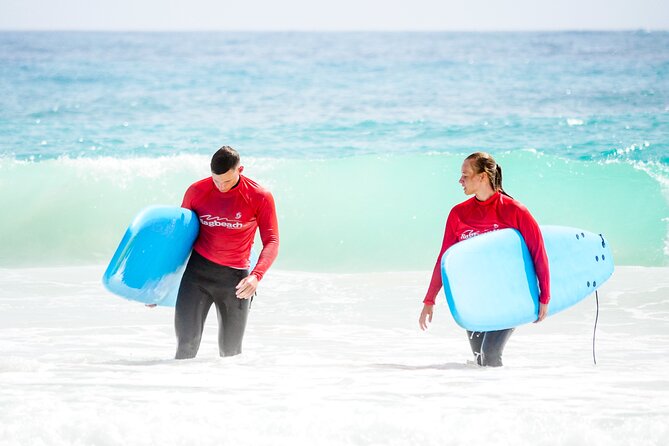
The surf is the main event, but the beach setting gives the lesson some extra appeal. One class went to a beach with impressive views, and another student enjoyed the lagoon. These details point to a useful part of the experience: the day is not only a technical exercise on a board.
You will have time between attempts to look around, catch your breath, and take in the coast. The exact scenery depends on the beach selected, so it would be wrong to promise a particular lagoon or viewpoint. Still, the school’s range of locations means you may see a different part of the coast than you would on a fixed beach activity.
That variety can also make the lesson feel less repetitive. You are learning a new skill, but you are doing it in an outdoor setting rather than inside a pool or a formal training room.
Is $66.01 a fair price?
At $66.01 per person, the price is reasonable if you use the full package. You receive about four hours of activity, pickup and return, a surfboard, a wetsuit, instruction, and access to a school that can select from several beaches.
The value is strongest for first-time surfers who would otherwise need to arrange transport and equipment separately. Those costs can add up quickly, and the convenience of having the school manage the day is worth something.
The value is less obvious if you already own equipment, know the local beaches, and only want a short coaching session. In that case, you may be paying for services you do not need. The class is aimed more at beginners and improving novices than experienced surfers looking for independent water time.
A rating of 4.7 from 19 ratings, with 95 percent recommending the experience, suggests a dependable level of satisfaction. That is a small sample, so I would not treat it as a guarantee. Still, the praise is consistent in the areas that matter most: friendly instructors, clear explanations, hotel pickup, good beach choices, and useful help catching waves.
Who will get the most from this lesson?
This is a good match for you if you are trying surfing for the first time, traveling without equipment, or want a guided introduction instead of figuring out the coast alone. It also suits solo participants, since the group format gives you a ready-made activity without needing a partner.
Families may find it useful as well. The experience is open to most people, and the successful coaching of a 13-year-old suggests that older children can take part. The supplied information does not give a minimum age, so confirm that point before booking for a younger child.
People who want a multi-day progression may also like the school. One participant originally booked three days, then added another session after enjoying the experience. A single four-hour lesson can give you the basics, while extra sessions may help you improve your balance and wave timing.
This is less suitable if you need a fixed timetable, a guaranteed beach, or a meal included. It also may not be the best choice for someone seeking advanced coaching, since the stated focus is an introductory course and the beach selection favors accessible breaks.
Booking, weather, and simple planning tips
Confirmation is provided at booking, and mobile tickets are accepted. The activity is offered in English. Pickup is available, but you should make sure your hotel or apartment details are correct so the collection plan is clear.
Wear something practical for changing and bring food or water since lunch is not included. Keep your schedule open around the four-hour estimate because pickup, signing in, changing, and the drive can affect the total time.
The experience depends on good weather. If poor conditions force a cancellation, you can receive a different date or a full refund. You can also cancel for a full refund if you do so at least 24 hours before the local start time. Cancellations or changes made inside that 24-hour window are not refunded or accepted.
Should you book Flag Beach?
I would book this lesson if you want a friendly, organized first step into surfing around Puerto del Rosario. The combination of small groups, included equipment, hotel pickup, and several possible beaches gives you more practical support than a basic beach rental.
Book with modest expectations. You may stand and ride a few waves, but nobody can promise that result in one class. You should also accept that the beach and instructor may vary, and that lunch is not part of the price.
For a beginner, the flexible location choice and patient coaching from instructors such as Alex, Christian, Lorenzo, Igor, and Pawel make this a good-value introduction. If you want to build real confidence, consider another session after the first one. Surfing rewards repetition, and this school gives you a sensible place to begin.
FAQ
Where does the surf lesson take place?
The lesson is based in Puerto del Rosario, but the exact beach can change. Flag Beach chooses from about eight to ten beaches, mainly beach breaks, with some easy reef breaks also available.
Does the experience include pickup?
Yes. Pickup is offered from your hotel or apartment, and the return is described as being to the same location.
What equipment is included?
The price includes a surfboard and wetsuit. Lunch is not included.
How long does the activity last?
The advertised duration is about four hours. The drive from the office to the selected beach can take 20 to 25 minutes, depending on the teaching location.
How many people can join the class?
The maximum group size is eight people.
What happens if the weather is poor?
The experience requires good weather. If it is canceled because of poor conditions, you can choose a different date or receive a full refund.
Just added for surfers in Spain
- Valencia: Excursión en Moto de Agua + Paddle Surf★ 4.9 · 9 reviews
- Surf lesson on Valencia beach★ 3.5 · 5 reviews
- small group surf lesson in Playa de las Américas,Tenerife★ 5.0 · 31 reviews
- Surfing Lesson in La Mata Beach★ 5.0 · 51 reviews
- Surf Lessons at El Médano Beach★ 4.5 · 7 reviews
- Surfing lessons in Las Americas★ 5.0 · 32 reviews
- Tenerife Paddle Surf and Snorkeling Experience★ 5.0 · 4 reviews
- Private couple Surf Lesson★ 5.0 · 34 reviews
Spain Surf Lessons, compared.
Surfing Lesson for All Levels, Photos included
Read our review →
Group Surfing Lesson at Playa de las Américas, Tenerife
Read our review →
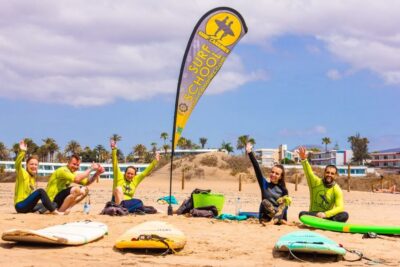
Playa del Inglés Maspalomas: High Quality Surf Classes
Read our review →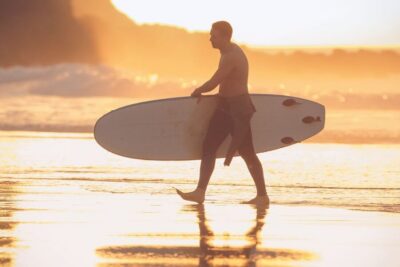

Lezioni di Surf per Beginner e Intermedi (6 persone a istruttore)
Read our review →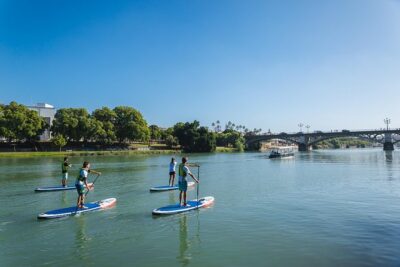
Browse the lists this tour appears in