
Review · JEFFREYS BAY
Jeffreys Bay: Private Surfing Lesson for Beginners
The best part of this Jeffreys Bay lesson is its clear goal: stand up and ride your first wave. You begin with basic movements on the beach, then take those skills into waist-deep water with a private coach beside you. I like the one-to-one format and the fact that a board, wetsuit, changing room, and safe storage are included.
I also like the practical finish. You are not simply pushed onto a board and sent home: you learn how to paddle, catch a wave, stand, and continue practicing on your own. The main drawback is that surfing depends on the ocean and weather, so a session may be rescheduled or canceled. Non-swimmers and wheelchair users cannot take part.
Key points at a glance
- Private coaching: Your lesson takes place in a private group, allowing the instructor to focus on your balance, timing, and first attempts.
- A real beginner progression: Practice starts on the sand, continues in waist-deep water, and builds toward catching and riding a wave.
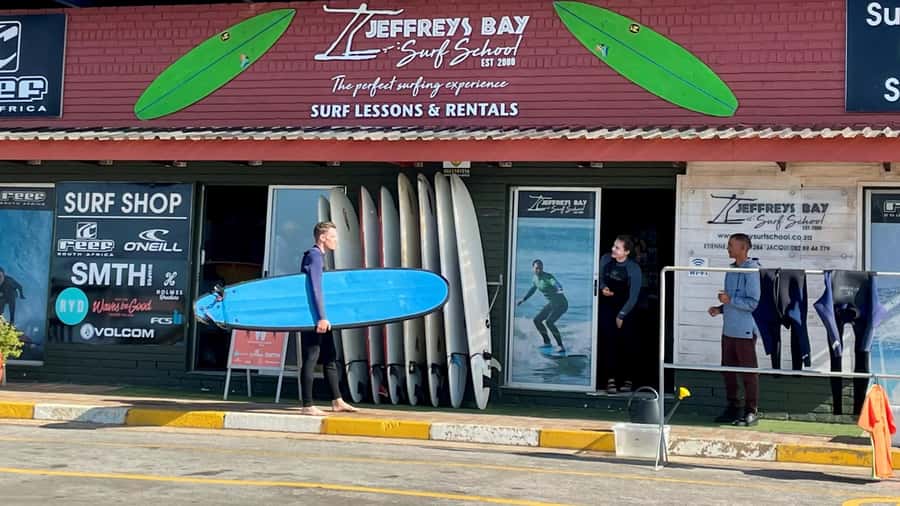
- Jeffreys Bay setting: You learn at one of South Africa’s best-known surf destinations, at the area’s oldest surf school.
- Everything essential is supplied: A surfboard, wetsuit, changing room, and safe storage are included in the $43 price.
- Photos from the session: Pictures are taken as you learn, giving you a record of those first attempts.
- Coach Ernie gets specific praise: Two recent German and Belgian bookings singled out Ernie’s instructions, helpful tips, and ability to get beginners standing by the end.
Starting at Jeffreys Bay’s oldest surf school
Jeffreys Bay is a fitting place to try surfing. This lesson takes place at the town’s oldest surf school, so you are learning in a location with a long connection to the sport rather than treating surfing as a quick beach add-on.
The lesson lasts two hours. That is long enough to move through the basic steps without turning the session into an all-day commitment. You get time to listen, practice, make mistakes, and try again. For a first lesson, that steady rhythm matters more than a packed schedule.
Your instructor speaks English and is described as a qualified professional coach. Since this is a private group, you should receive more direct correction than you would in a large class. If your feet are landing too far apart, your balance is off, or you are mistiming the wave, the coach can focus on your particular problem.
That does not guarantee a perfect ride. Surfing asks a lot from a beginner: balance, paddling, timing, and a willingness to fall into the water. Still, private instruction gives you a better chance to understand what went wrong before your next attempt.
More Beginner Surf Lessons in the world:
- Legian Beach, Bali: Beginner or Intermediate Surf Lessons
★ 4.9 · 1,019 reviews - Maui: Two Hour Beginner Group Surf Lesson in Kihei
★ 5.0 · 950 reviews - Uluwatu: Beginner & Intermediate Surf Lesson with Equipment
★ 4.9 · 832 reviews
The first lesson happens on the beach
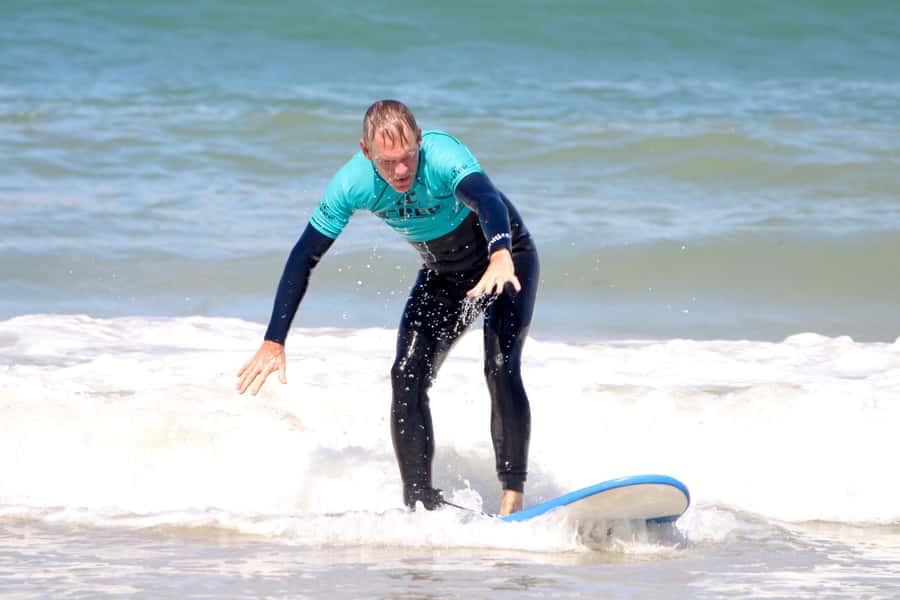
The session begins with practice on the sand. This is where you learn the basic movements before dealing with moving water.
You can expect to work on how to lie on the board, paddle, and move into a standing position. The beach practice gives you a chance to learn the sequence without also worrying about waves and balance. I like this approach because the first attempt at standing can feel awkward enough without adding every other new skill at once.
Your coach will also help you understand the basic aim of the lesson: catch a wave, rise from the board, and ride toward the beach. The instruction is practical rather than theoretical. You are learning movements that you will use minutes later in the water.
The photos taken throughout the session may include this early practice as well as your time in the waves. Do not expect a formal photo shoot. The value is that you can take home a visual record of your first surfing experience, including the effort before the successful ride.
Moving into waist-deep water
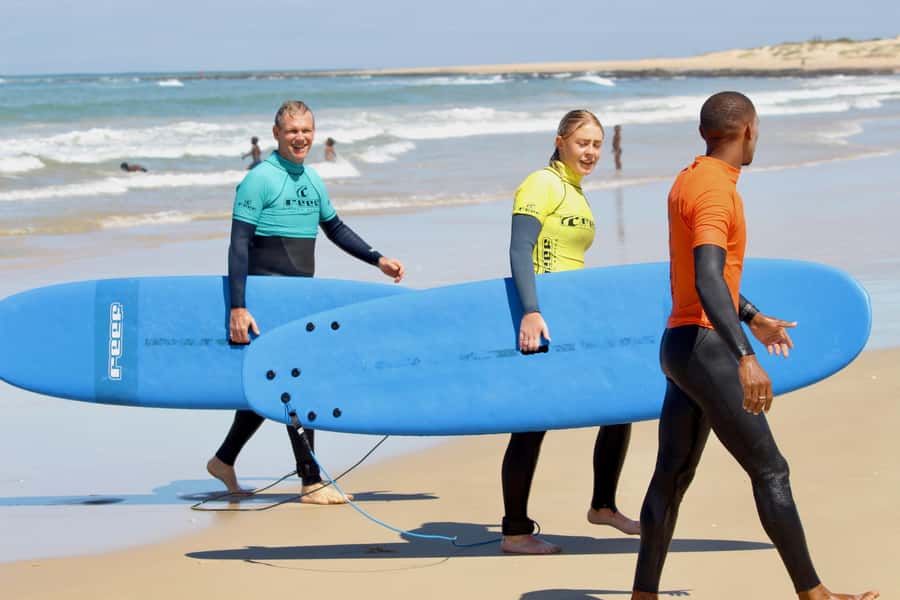
After the beach work, you practice in waist-deep water. This is an important middle step. You are no longer pretending to surf on dry sand, but you are not being asked to handle the full challenge of deeper water either.
The water work covers paddling and catching waves. You learn how to position yourself and how to respond when a wave gives the board forward movement. Your coach can offer tips as you practice, which is especially useful because surfing technique feels different once the board and water are moving beneath you.
The supplied equipment includes a board and wetsuit. That keeps the experience simple for visitors who do not own surf gear or do not want to pack it. You should bring your own swimwear, towel, sandals, and sunscreen. Changing rooms are available, and safe storage is provided for belongings.
There is no food or drink included, so plan accordingly outside the two-hour session. The lesson is focused on surfing rather than a full beach outing.
Working toward your first wave
The main goal is to stand up and ride a wave toward shore. That goal is realistic for a beginner lesson, but it is still affected by the ocean, your comfort in the water, and how quickly you pick up the movements.
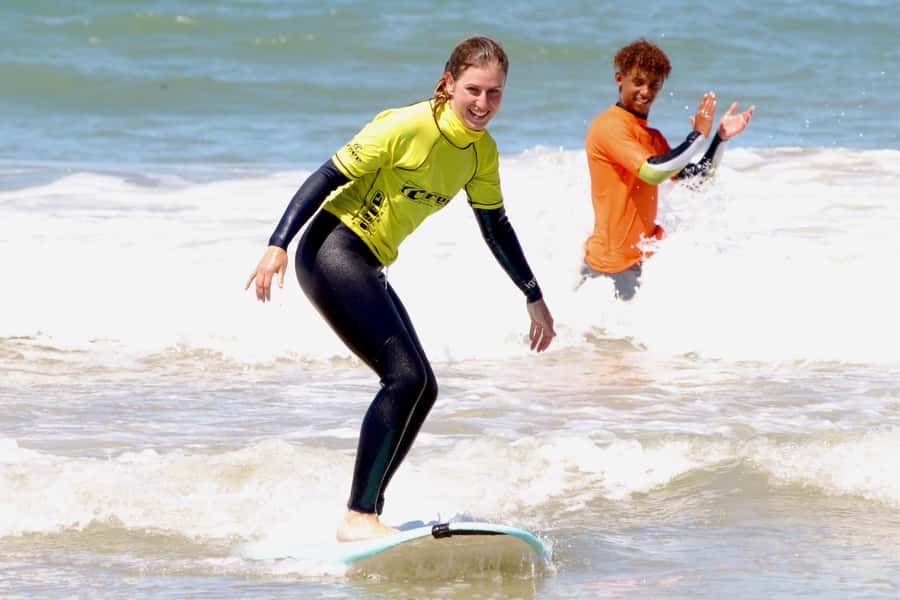
The instruction builds one step at a time. First comes paddling. Then you work on catching a wave. Once the board begins to move, you try to rise and find your balance. The coach helps you repeat the process until the movement begins to make sense.
Two recent bookings give useful detail about what a strong session can look like. Alessa from Germany described the instructions and small successes as a highlight and gave special credit to Ernie. Pien from Belgium also singled out Ernie’s helpful tips and said the lesson ended with the group able to stand. Those comments point to a coach who keeps the mood friendly while still giving clear direction.
That does not mean every person will stand on the first try. You may spend much of the session falling, resetting, and trying again. That is normal for a first surf lesson. The value is in learning the process, not in treating one successful ride as the only measure of the experience.
One rating from Germany gave the location full credit but scored the overall experience poorly. That mixed result is worth noting. The beach and setting are appealing, but your personal experience will depend heavily on the session conditions and the quality of the coaching on your particular day.
More Private Surf Lessons in the world:
- Private Surf Experience
★ 5.0 · 200 reviews - Private Surf Lesson for Two Near Lahaina
★ 5.0 · 189 reviews - Private Surfing Lessons in Waikiki
★ 5.0 · 176 reviews - Private Surfing Lesson
★ 5.0 · 173 reviews
What private group really changes
A private group does not remove the physical challenge, but it should make the lesson more personal. You have room to ask questions and receive corrections aimed at your own technique.
This can be especially useful if people in your party have different confidence levels. One person may need help with paddling, while another is already trying to stand. A private coach can adjust the pace rather than forcing everyone through an identical routine.
The format also suits people who prefer not to learn a new sport in front of a large class. You still need to accept some public wobbling and falling, but the instruction is centered on your private group.
The listing does not state how many people can be in each private group, so do not assume the lesson is strictly one person with one coach. The important point is that it is not described as a standard large-group class.
Is $43 good value?
At $43 per person, the price is reasonable for a two-hour beginner lesson that includes the main equipment and basic facilities. You are not paying separately for the board or wetsuit, and you also get access to changing rooms and safe storage.
The qualified coach is the biggest part of the value. Buying equipment would not help much if you did not know how to position yourself, paddle, or stand. The lesson gives you a structured introduction and enough practice to begin working on the basics independently afterward.
The photographs add a small extra benefit. They are not a replacement for instruction, but they give you a keepsake without requiring someone from your group to stay on the beach taking pictures.
The price is less attractive if you are looking for a full-day beach experience, meals, or transport. None of those are included. This is a focused lesson, and you should judge the cost against two hours of coaching and equipment rather than against a full excursion.
Ocean conditions are part of the bargain
Surfing cannot be separated from the weather and ocean. The lesson may be rescheduled or canceled if conditions are unsuitable. That is not a minor footnote: it affects how firmly you should build the session into a tight itinerary.
I would avoid scheduling this on the final morning before an important departure. Give yourself some flexibility, especially if catching your first wave is one of the main reasons you are visiting Jeffreys Bay.
The booking terms allow free cancellation up to 24 hours in advance for a full refund. You can also reserve now and pay later, which helps if your plans are still shifting. Even with those options, check the available starting times and keep an alternative activity in mind in case the ocean does not cooperate.
The lesson is available in English. If you need instruction in another language, the supplied details do not promise that option.
Who should book this lesson
This is a strong match for an adult or older child who can swim, wants a first introduction to surfing, and prefers personal coaching over a large class. It also works well for a couple or small private group that wants to share the first-wave experience.
You do not need prior surfing experience. The course is built around basic skills, with instruction beginning on the beach before moving into the water.
You do need to be comfortable in water and able to swim. Non-swimmers cannot take part. The experience is also not suitable for wheelchair users, and no accessibility adaptations are stated.
Bring swimwear, a towel, sandals, and sunscreen. You should also expect to get wet, fall, and repeat the same movement several times. Surfing lessons are active rather than relaxing, even when the beach setting feels calm.
Small details that make the session easier
Wear swimwear under the wetsuit and bring a towel for afterward. Sandals are useful around the changing area and beach, while sunscreen matters even when the air feels cool.
Leave valuables in the provided safe storage rather than taking them toward the water. Card facilities are available, so you do not need to depend only on cash for related purchases at the school.
Keep your plans flexible around the lesson time. The activity lasts two hours, but the starting time depends on availability, and ocean conditions can affect the schedule.
Most of all, listen closely during the beach practice. The standing motion can feel simple when demonstrated and surprisingly difficult when you try it on a moving board. Paying attention before entering the water gives you a better foundation for the short practice period that follows.
Should you book the Jeffreys Bay surf lesson?
Book it if you want a focused, reasonably priced introduction to surfing with equipment supplied and a private English-speaking coach. The strongest reasons are the clear beginner progression, the chance to work toward standing on a wave, and the personal attention that comes with a private group.
The lesson is especially appealing if photographs of your first attempts matter to you or if you want a practical skill rather than a passive beach activity. Coach Ernie’s specific praise for clear tips and helping beginners stand is encouraging, though your result will still depend on conditions and your own confidence.
Skip it if you cannot swim, need wheelchair access, require a guaranteed schedule, or want food and a longer sightseeing program included. For everyone else, $43 buys a useful two-hour start in one of South Africa’s best-known surfing towns, with enough instruction to keep practicing after the coach leaves.
FAQ
How long does the surfing lesson last?
The lesson lasts two hours.
How much does the lesson cost?
The price is $43 per person.
Is the lesson suitable for complete beginners?
Yes. The course is designed for beginners and covers paddling, catching waves, standing up, and riding toward the beach.
Is the lesson private?
It is offered as a private group experience.
What language does the instructor speak?
Instruction is provided in English.
Is a surfboard included?
Yes. A surfboard is included in the experience.
Is a wetsuit provided?
Yes. A wetsuit is included.
Are photographs included?
Photographs are taken throughout the session, allowing you to take home souvenirs of your first surfing experience.
What should I bring?
Bring swimwear, a towel, sandals, and sunscreen.
Can the lesson be canceled because of the weather?
Yes. The lesson depends on weather and ocean conditions and may be rescheduled or canceled if conditions are unsuitable. You can cancel up to 24 hours in advance for a full refund.
Just added for surfers in the world
- Muizenberg Cape Town: Private Surf Lesson★ 5.0 · 37 reviews
- 8 Day Outstanding Surf & Yoga Holiday in Tamraght, Agadir★ 5.0 · 18 reviews
- Surf, Stay and Yoga in Byron Bay 2 day 2 night★ 5.0 · 10 reviews
- Surf Rental★ 5.0 · 31 reviews
- Surf, Yoga & Glamping Weekend in Cornwall★ 5.0 · 33 reviews
- Cocoa Beach: Surfing Lessons & Board Rental★ 4.7 · 24 reviews
- Surfing and Yoga in Lisbon★ 5.0 · 15 reviews
- From Sayulita: La Lancha Surf Trip w/ Transportation★ 4.6 · 5 reviews
Private Surf Lessons, compared.

Private Surfing Lesson at Playa de las Américas
Read our review →
Private Surf Lesson Experience at Puerto Vallarta
Read our review →Browse the lists this tour appears in