Review · MUNICH
Munich: Eisbachwelle River Surfing Experience
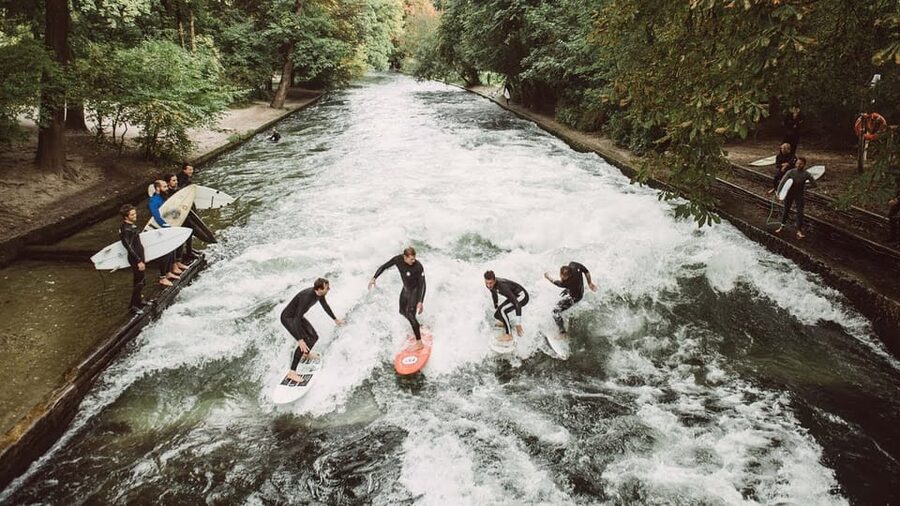
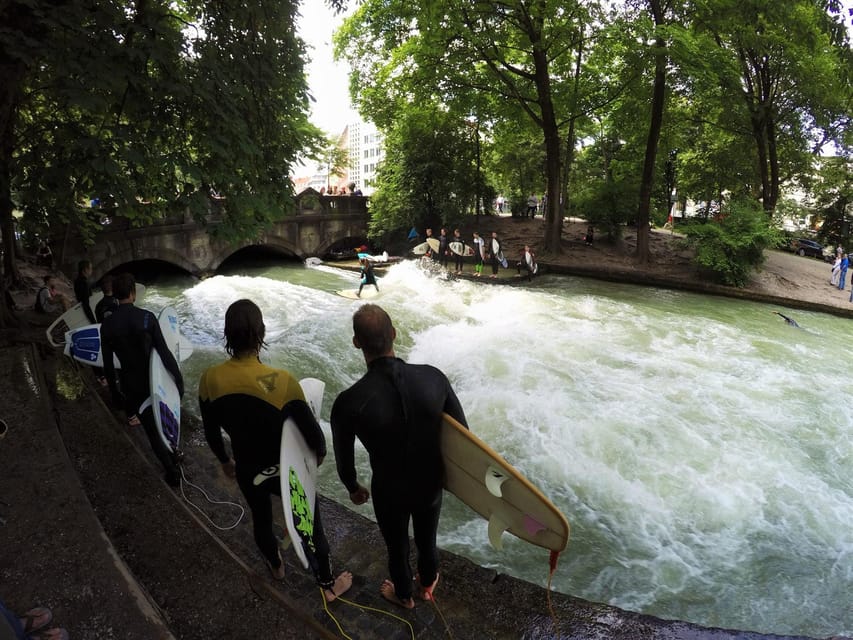
Munich’s Eisbachwelle is a standing river wave in the middle of the city, beside Haus der Kunst and at the entrance to the Englischer Garten. You do not need an ocean, a beach, or a long trip to reach it. You need a board, nerve, balance, and a willingness to get very cold.
I like two things right away: all equipment is included, including a thick hooded wetsuit and soft-top board, and guide Max stays close to help you work through the technical parts. The small group, capped at 10, also keeps the session more personal. The other big plus is the setting: you are surfing in a famous Munich park, with city life carrying on around you.
The catch is simple: this is a real river, not a gentle practice pool. The water is cold, the wave is technical, and surfing is at your own risk. You must be a swimmer, at least 150 centimeters tall, and comfortable with a physically demanding activity.
Key points to know before booking
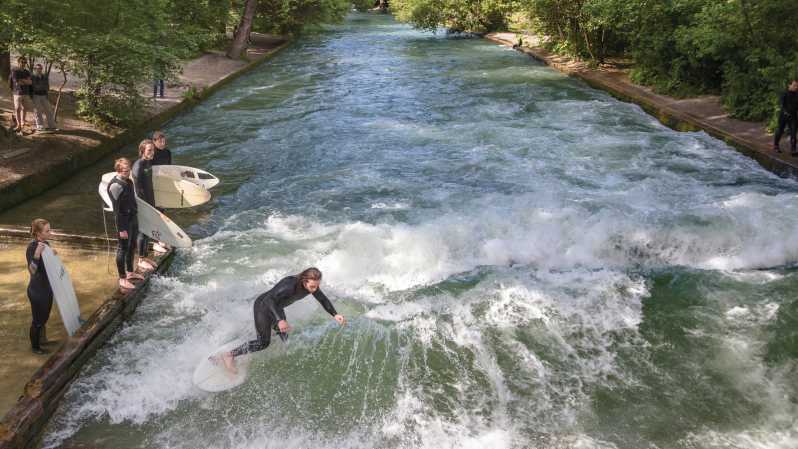
- The Eisbachwelle runs year-round: River surfing is possible in every season, with sessions offered at 8 a.m., noon, or 3 p.m., subject to availability.
- A full kit is provided: You get a 7-foot soft-top board, leash, fins, 5 mm hooded wetsuit, 4 mm booties, and surf wax.
- Max leads the session: He provides instruction and assistance in English, German, or Spanish, with photos and drinks included.
- The wave is for beginners and intermediates: The activity teaches the basics, but the river remains technical and demanding.
- Safety matters at every moment: Swimmers and surfers coming from upstream have the right of way, and underwater objects can be present.
- The setting is unusually central: The wave sits beside Haus der Kunst at the Englischer Garten, so this is a genuine city experience rather than a remote sports outing.
Why the Eisbachwelle is such a Munich experience
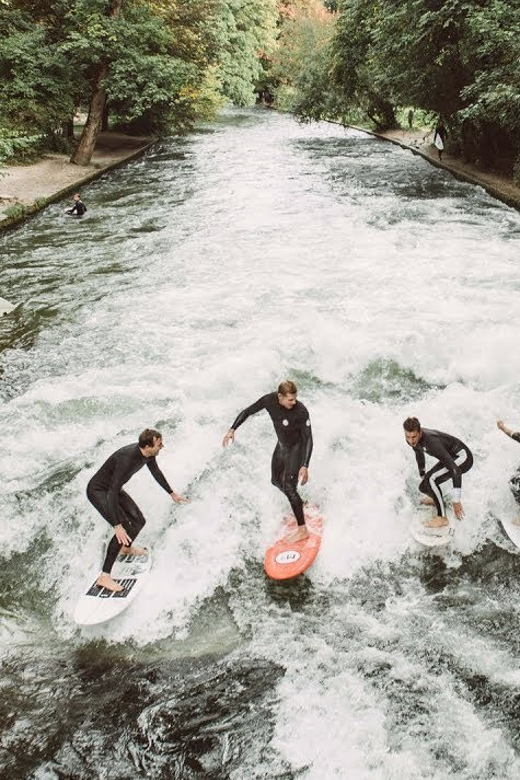
Munich is known for beer halls, grand squares, and palace rooms. It is also one of Europe’s best-known river-surfing cities. The Eisbach, a small man-made side arm of the Isar, creates a wave that keeps breaking in one place. That makes it possible to surf in a city far from the coast.
The wave is part sport, part local culture, and part public spectacle. Cyclists carrying surfboards through Munich have become a normal sight. At the Eisbachwelle, you can watch surfers work the wave while people pass through the park and stop to look.
This session gives you more than a quick photo beside the water. You get time to learn how the board behaves, how to position yourself, and how to respond when the river pushes back. That matters because river surfing is not simply ocean surfing transferred inland. The water moves continuously in one direction, the wave does not travel toward shore, and the current creates its own set of problems.
The location is excellent for a first attempt. It is centrally placed, easy to pair with a visit to the Englischer Garten or Haus der Kunst, and memorable even if your first ride lasts only a few seconds. You do not need to spend a full day traveling to an outdoor sports center.
More Surf Lessons in the world:
- Tenerife: Surfing Lesson for All Levels, Photos included
★ 4.9 · 1,314 reviews - Group Surfing Lesson at Playa de las Américas, Tenerife
★ 5.0 · 1,072 reviews - Canggu: 2-Hour Surf Course
★ 4.8 · 1,053 reviews
Meeting Max beside the city’s famous wave
The session lasts three hours, with starting times listed at 8 a.m., noon, or 3 p.m. You should check the confirmed time when booking and contact the provider through WhatsApp if you have questions. The listed guide is Max, and instruction is available in English, German, or Spanish.
A three-hour slot gives the activity room to breathe. You are not being handed a board and rushed into the current. The time covers preparation, safety guidance, equipment, practice, and repeated attempts. That is important for beginners, since balancing on a moving river wave usually takes patience.
The group limit is 10 people. That is not private coaching, but it is small enough for a guide to keep track of the group and offer corrections. Max’s role includes assistance, not just a quick explanation at the riverbank. You can expect practical help with technique and support while you focus on staying upright.
The session also includes photos and drinks. These are useful extras rather than the main reason to book. Photos let you take home a record of the attempt, while a drink afterward is welcome after time in cold water.
Getting into the wetsuit and choosing the board
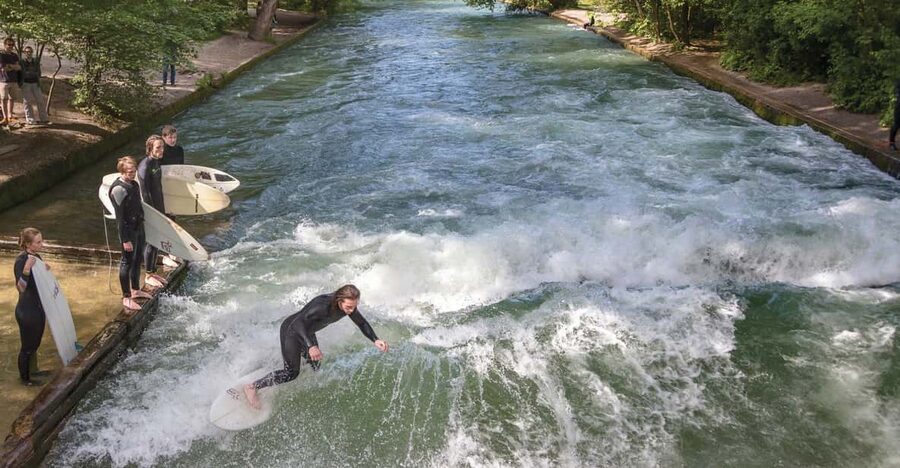
The supplied gear is designed to make the first session more forgiving. You receive a 7-foot soft-top board with leash and fins. Soft-top boards have more volume and stability than many hard boards, which gives a beginner a better chance of finding balance.
They are also less likely to cause a serious injury if the board hits you. That is a meaningful point in a river, where the current can separate you from your board quickly. Soft tops can take knocks that would damage epoxy or polyester boards, too.
The wetsuit is a full one-piece 5 mm neoprene suit with an integrated hood. You also get 4 mm neoprene surfing booties. This is not a warm-weather swim in a mild river. The hood and booties are important parts of the kit, especially outside the height of summer.
Surf wax is included, helping your feet stay planted on the board. You should bring outdoor clothing and a complete change of clothes. A dry change is not a minor comfort after three hours around cold water. You should also bring a passport or ID card, as requested for the activity.
The equipment list covers the main costs that could otherwise catch you by surprise. You do not need to rent a board, buy a wetsuit, or find booties separately. That makes the $170 price easier to judge, especially if this is a one-time Munich activity rather than a sport you already practice.
Learning a technical wave instead of chasing a beach break
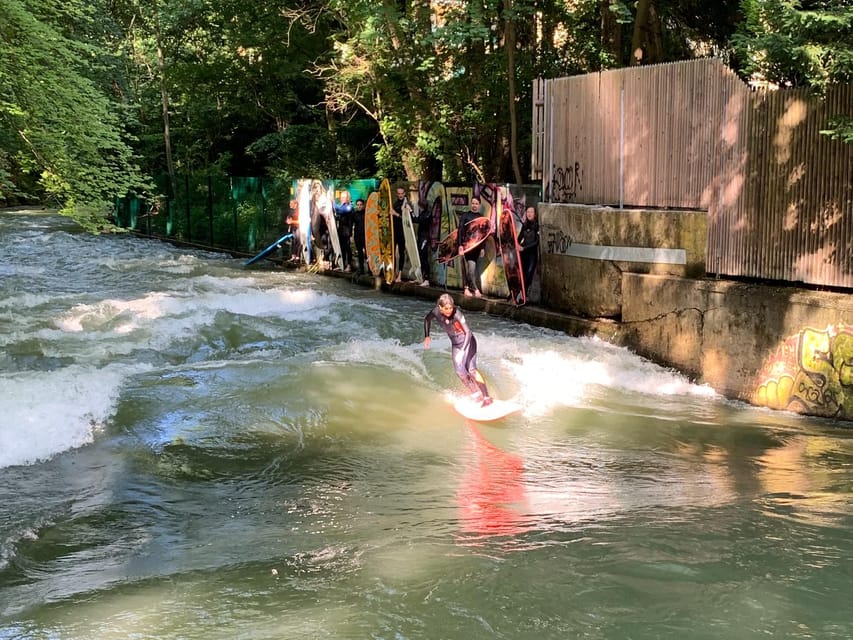
At the Eisbachwelle, the goal is not to paddle toward a wave. The wave stays in place while the river flows beneath you. You need to enter correctly, find your balance, and keep the board aligned with the moving water.
The activity is open to beginners and intermediates, with advanced surfers also listed as eligible. For a beginner, the first lesson is control. You need to understand where to place your feet, how to keep your weight centered, and how to react when the board shifts.
The wave is technical, so progress may come in small steps. You might spend part of the session learning how to approach the wave before you manage a steady ride. That is normal for this kind of surfing. It is better to judge the experience by the quality of the instruction and the chance to improve than by expecting a long ride on your first try.
Max’s coaching is especially useful here. Good advice can help you correct a small mistake before it becomes a fall. You may also try a 42-inch bodyboard, which gives the session another way to experience the current and wave.
The activity is not just for strong surfers. It is for beginners who can swim and accept a physical challenge. Still, you should be honest with yourself. If you dislike cold water, have poor water confidence, or want a calm sightseeing activity, this is the wrong choice.
Same break, a different way into the water:
- Legian Beach, Bali: Beginner or Intermediate Surf Lessons
★ 4.9 · 1,019 reviews - Playa de las Américas: Private or Small-Group Surf Lesson
★ 4.8 · 980 reviews - Maui: Two Hour Beginner Group Surf Lesson in Kihei
★ 5.0 · 950 reviews - Bondi Beach: 2-Hour Surf Lesson Experience for Any Level
★ 4.9 · 935 reviews
Safety rules that matter at the Eisbach
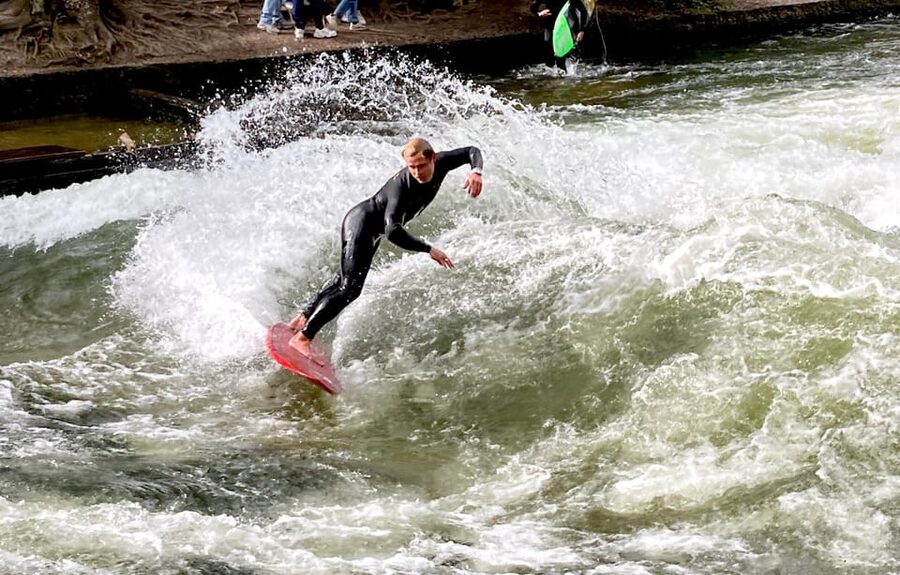
The most important rule concerns the upstream approach. Before entering the wave, you must check for swimmers or surfers coming from upstream. Anyone coming from upstream has the right of way.
This is especially important in summer, when many people swim down the river. The Eisbach is not a closed training facility with a controlled flow of participants. Other people may be in the water, and you are responsible for paying attention.
You also need to watch for objects underwater. The river is a natural and built urban waterway, not a polished recreational pool. The current, board, and surrounding structures all require care.
Surfing at the Eisbachwelle is tolerated in Munich and takes place at your own risk. The activity provider makes that risk clear, and you must acknowledge it before taking part. The session includes guidance, but instruction does not remove the basic danger of river sports.
There is an easy exit about 100 meters downstream on the left side of the canal when facing downstream. It looks like a ramp and can help if you have trouble climbing out because of an injury. You should know where it is before you enter the water.
These details may sound serious, but they are useful. A good outdoor activity gives you the information needed to make sensible choices. Listen carefully, wait when necessary, and do not let excitement push you into the wave before you are ready.
What the three-hour session feels like
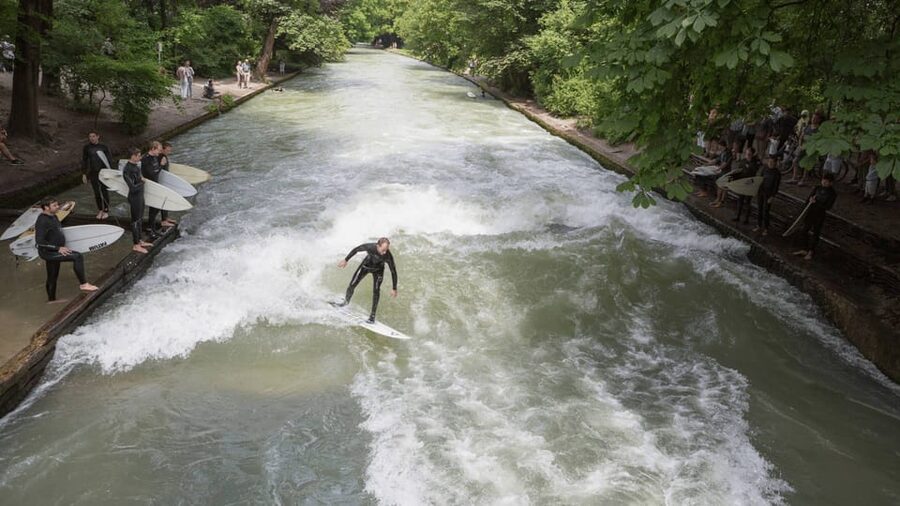
The session begins with meeting the guide, receiving the equipment, and getting prepared. You will be fitted with the wetsuit, hood, booties, and board. Expect the early part to focus on how the wave works and how to stay safe around the water.
You then move into practical instruction. The guide can explain the basics of the board and help you understand the correct approach. The supplied soft top gives you more stability than a narrow hard board, but it does not turn the Eisbach into an easy ride.
As you make attempts, the session becomes a cycle of trying, falling, listening, and trying again. The water temperature may be the biggest surprise, particularly in late autumn or winter. The thick suit helps, but you should still expect the cold to be part of the experience.
The guide also takes photos during the activity. This lets you concentrate instead of trying to manage your phone around fast-moving water. Drinks are included, and they make sense as part of the recovery after your time in the river.
You may finish with a better understanding of why experienced surfers return to the Eisbach again and again. The wave is compact, demanding, and never quite passive. Even a short successful ride can feel like a real achievement because you are managing a moving river in the middle of Munich.
The location adds value beyond the surfing
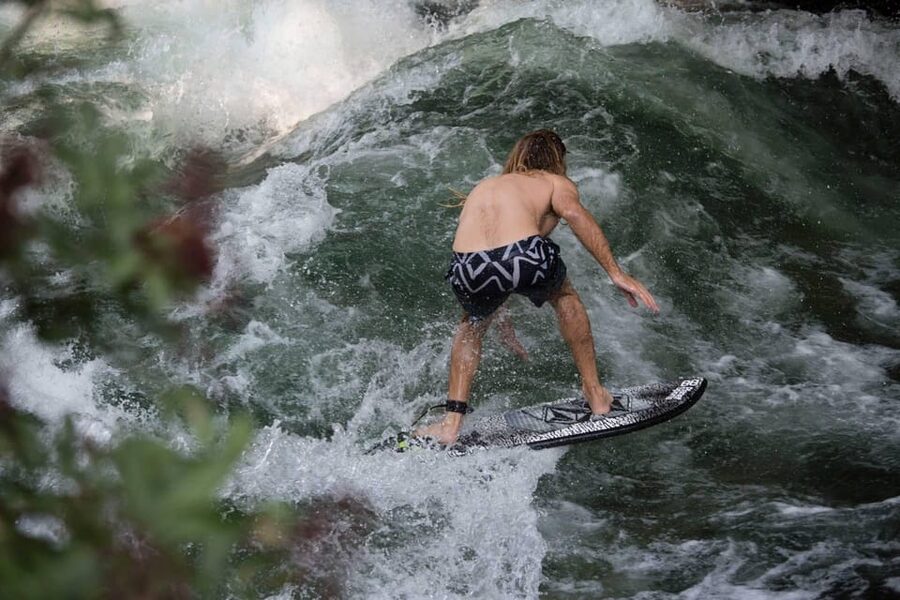
The Eisbachwelle is next to Haus der Kunst and near the entrance to the Englischer Garten. This gives you a strong way to combine the activity with other parts of your Munich day.
The setting also changes the feel of the experience. You are not hidden away at a specialist resort. You are in a central urban park, surrounded by the daily rhythm of the city. Surfing here connects modern Munich with its rivers, parks, and outdoor habits.
The wave has appeared in films, commercials, and social media, so you may already recognize the scene. Seeing it on a screen is different from standing beside the fast water and watching someone hold position on a stationary wave.
You should allow enough time around the session to change clothes and continue your day comfortably. The experience lasts three hours, and you should not treat it as a quick stop between two tightly scheduled museum visits.
Is $170 a fair price?
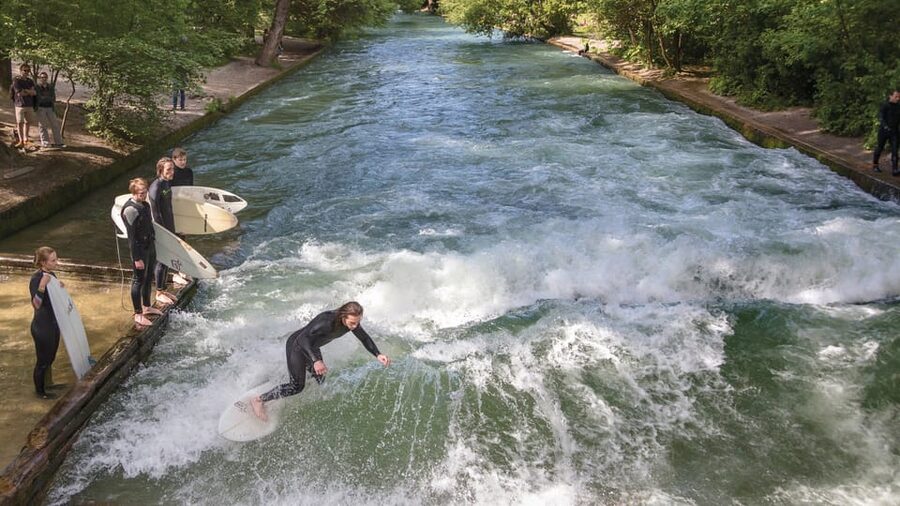
At $170 per person, this is not a budget activity. The value depends on what you want from your Munich visit and whether you already own river-surfing equipment.
The price includes the board, leash, fins, wetsuit, hood, booties, wax, instruction, assistance, photos, and drinks. It also gives you a three-hour session with a guide and a group limited to 10. If you had to source that equipment yourself, the convenience would drop quickly.
The strongest value is for a first-time participant. You can try a very specialized sport without buying a board or a cold-water suit. You also get direct instruction in a place where attempting to learn alone would be a poor idea.
For an experienced surfer who already has gear and knows the Eisbach, the package may be less attractive. You are paying for guidance and a supported experience, not simply access to the wave. The same is true if you mainly want to watch the surfers. You can see the wave without paying for a session.
The free cancellation period of 24 hours and reserve-now, pay-later option add useful flexibility. They do not make the activity inexpensive, but they reduce the risk of committing too early to a weather-sensitive outdoor plan.
Who should book this experience?
I would choose this for an adult who swims confidently, wants an unusual Munich activity, and is willing to accept a few falls. It suits active visitors who prefer doing something memorable over spending another afternoon indoors.
It is also a good choice for someone curious about river surfing but unsure about buying equipment. The full kit and coaching let you test the sport before making a larger commitment.
The session is not suitable for children under 18, pregnant women, people with mobility impairments, non-swimmers, or people with epilepsy. It is also not suitable for anyone under 150 centimeters or over 125 kilograms. These restrictions are practical safety limits, not minor booking details.
You should pack outdoor clothing and dry clothes, and plan for the cold. If you are hoping for a relaxed float through a park, choose another activity. If you want a demanding, local, and slightly wild city experience, this is a strong candidate.
Should you book the Eisbachwelle session?
Book it if you want to do something that could happen almost nowhere else in a major European city. The combination of central Munich, a famous standing wave, full equipment, and hands-on help from Max gives the session a clear purpose.
I especially like that the package does not leave you to solve the hardest practical problems yourself. The soft-top board, 5 mm hooded wetsuit, booties, photos, drinks, and small group all make the first attempt more manageable.
Skip it if cold water, falls, or personal risk are deal-breakers. The Eisbach is not a staged attraction, and no guide can make the river harmless.
For the right person, though, the price buys more than three hours on a board. It buys a chance to take part in one of Munich’s most distinctive outdoor traditions, right beside one of the city’s best parks.
FAQ
Where does the river-surfing experience take place?
It takes place at the Eisbachwelle beside Haus der Kunst, at the entrance to Munich’s Englischer Garten.
How long does the activity last?
The experience lasts three hours.
What start times are available?
The listed meeting times are 8 a.m., 12 p.m., and 3 p.m. You should check availability for the date you want.
Who leads the session?
The guide is Max. Instruction is available in English, German, and Spanish.
What equipment is included?
You receive a 7-foot soft-top surfboard with leash and fins, a 42-inch bodyboard to try, a full 5 mm hooded wetsuit, 4 mm neoprene booties, and surf wax.
Is the experience suitable for beginners?
Yes. The activity is listed for beginners, intermediates, and advanced surfers. The Eisbach wave is still technical, so beginners should expect a genuine physical challenge.
Do I need to know how to swim?
Yes. The activity is not suitable for non-swimmers.
What should I bring?
Bring a passport or ID card, outdoor clothing, and a change of clothes.
Can I cancel the booking?
You can cancel up to 24 hours in advance for a full refund. A reserve-now, pay-later option is also available.
Just added for surfers in the world
- Surf Rental★ 5.0 · 31 reviews
- Surf, Yoga & Glamping Weekend in Cornwall★ 5.0 · 33 reviews
- Cocoa Beach: Surfing Lessons & Board Rental★ 4.7 · 24 reviews
- Surfing and Yoga in Lisbon★ 5.0 · 15 reviews
- Muizenberg Cape Town: Private Surf Lesson★ 5.0 · 37 reviews
- 8 Day Outstanding Surf & Yoga Holiday in Tamraght, Agadir★ 5.0 · 18 reviews
- Surf, Stay and Yoga in Byron Bay 2 day 2 night★ 5.0 · 10 reviews
- Raglan: Private Surf lesson 2:1★ 5.0 · 3 reviews
Surf Lessons, compared.
Surfing Lesson for All Levels, Photos included
Read our review →
Group Surfing Lesson at Playa de las Américas, Tenerife
Read our review →
Legian Beach, Bali: Beginner or Intermediate Surf Lessons
Read our review →