

Review · BYRON BAY
Small-Group Surfing Lessons in Byron Bay
Byron Bay is a fine place to learn surfing because you get a real beach session without giving up half your day. The lesson uses a calmer section of Main Beach, where you can work on the basics before heading into the water. I especially like that boards, wetsuits, rash vests, and sunscreen are included, and that the teaching stays personal with a maximum of six students per instructor. I also like that instructors such as Mitch, Jonny, Jade, Ava, and Blake are praised for patient, useful coaching.
The main consideration is that the sea decides how easy the lesson will feel. Small waves can be ideal for a first attempt, while rougher conditions may slow your progress, even with good instruction. Also check the group size when you book, since one earlier customer expected a smaller group, although the operator clarified that the limit is six students per instructor.
Key points before you book
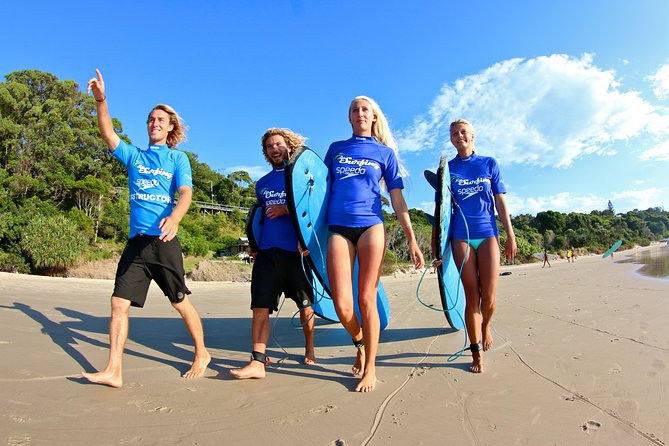
- Beginner-friendly Main Beach setting: The lesson takes place in an area described as having calmer surf, useful when you are learning to paddle, balance, and rise to your feet.
- Two hours of active instruction: Allow extra time before the lesson to change, sign the waiver, apply sunscreen, and meet the instructors.
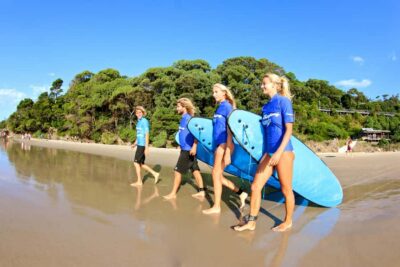
- Equipment is supplied: You receive a surfboard, wetsuit, rash vest, and sunscreen, so you do not need to arrange the main gear yourself.
- Small-group coaching: The stated limit is six students per instructor, with no more than 10 people on the activity.
- A real chance to stand up: Some first-timers managed to get to their feet during the first lesson, though results depend on the waves and your own balance.
- Simple Byron Bay meeting point: You meet at 5/11 Fletcher St and return there at the end. Hotel pickup and snacks are not included.
Learning to surf at Byron Bay’s Main Beach
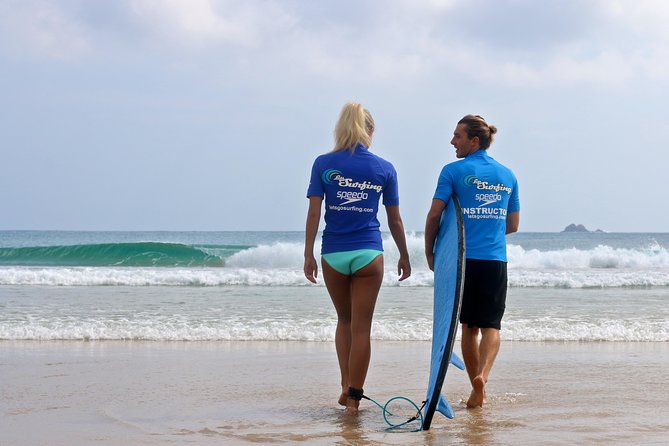
The best part of this lesson is its useful mix of holiday fun and a skill you can carry to another beach. You are not simply being pushed into the water for a quick photograph. The session introduces the basic movements, gives you time to practise on the sand, and then lets you try them in the surf with an instructor nearby.
That order matters. Standing on a board looks simple until you try to move from lying down to a balanced stance while a wave is carrying you forward. The beach practice gives you a chance to understand the foot position and body movement before the water adds speed and distraction.
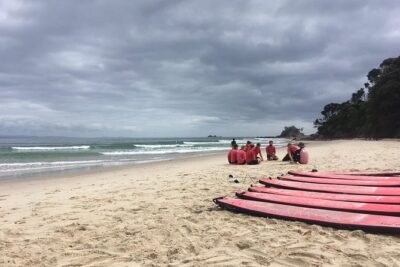
The setting also helps. The session uses a calmer part of Main Beach, which is a sensible choice for beginners. Calm does not mean flat or guaranteed. The sea can still be rough on the day, and your success will depend partly on the conditions. Still, the location gives a new surfer a fair place to begin.
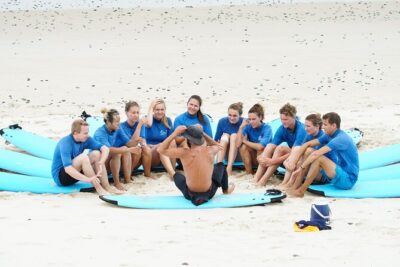
I like the tone of the experience. The teaching is described as chilled out rather than intense, but the lesson still has a clear structure. You meet the instructors, warm up, learn the basic technique on land, and then move into the water for guided practice.
More Group Surf Lessons in Australia
- Byron Bay: 2-Hour Small Group Surf Lesson
★ 4.8 · 657 reviews - Merrick’s Noosa Learn to Surf: 2 Hour group surfing lesson
★ 5.0 · 222 reviews - Group Surfing Lessons Kool Katz 1 day
★ 4.5 · 207 reviews
The meeting point at 5/11 Fletcher Street
You begin at 5/11 Fletcher St in Byron Bay. Plan to arrive 20 minutes before the scheduled start, not at the last minute. That early arrival is used for changing into your swimmers, wetsuit, and rash vest, along with applying sunscreen before the lesson begins.
This meeting point is also where the experience ends. There is no hotel pickup or drop-off, so you need to make your own way there. The location is near public transportation, which makes the arrangement fairly straightforward if you are staying in Byron Bay without a car.
A mobile ticket is provided, so you can keep the booking details on your phone. You will also need to sign a waiver before taking part. It is a small but important piece of preparation, and arriving early keeps it from cutting into your water time.
Bring the personal items the operator does not supply, including your swimmers and anything else you want after the lesson. Snacks are not included, so plan around that if you expect to be hungry after two hours in the water.
Stage one: getting ready and meeting the instructors
The first part of the session is practical rather than glamorous. You change into the supplied wetsuit and rash vest, apply sunscreen, and meet your instructor. This is when you get settled and ready for the conditions at Main Beach.
The wetsuit is useful beyond modesty and comfort. It helps you stay in the water for the lesson, while the rash vest adds another layer for protection from rubbing and sun. Since both are supplied, you avoid the trouble and cost of hiring separate equipment before arriving.
The teaching team has earned particularly strong praise for patience and personal attention. Mitch is described as helping students with technique and assisting them into waves. Jonny is noted for explaining the theory and giving students a chance to practise standing on the board on land. Jade is praised for offering specific feedback and paying close attention.
Those details tell me what to expect from the instruction. You should not assume that every student receives a private coach, but the group ratio gives the instructor room to correct basic mistakes and offer guidance when you are trying to catch a wave.
Stage two: warm-up and beach practice
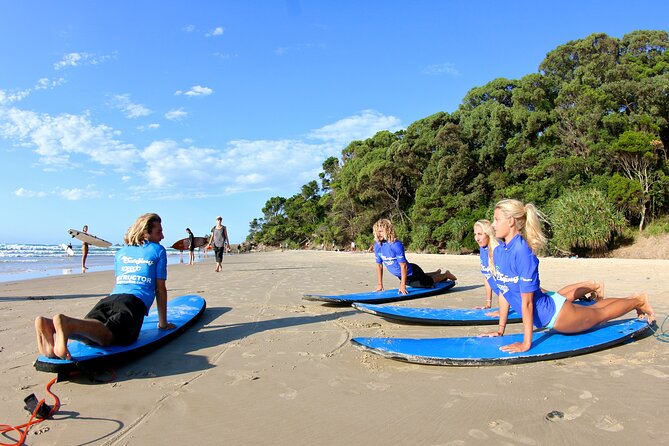
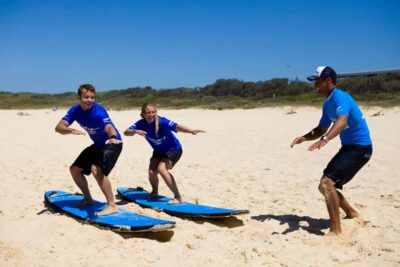
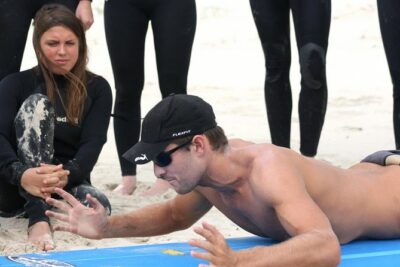
After the introduction, the group warms up and works through the movements on the beach. This is the part where you learn the basic sequence without the added pressure of moving water.
Expect the instructor to focus on how you lie on the board, how you position your hands, and how you move into a standing position. The supplied information does not give a full technical lesson plan, so I would not expect a long classroom session. The theory is there to support the practical work, not replace it.
The beach practice is especially useful for first-timers. One customer singled out the chance to practise standing on the board on land before entering the water. That preparation can make a real difference, since you can pay attention to body position rather than trying to understand the movement while a wave is already pushing you along.
If you have surfed before, this stage may feel basic. That is not a flaw. A beginner lesson needs to establish the same foundation for everyone, and the small-group format may let an instructor give you a few adjustments if you are brushing up on old skills.
Same break, a different way into the water:
- Bondi Beach: 2-Hour Surf Lesson Experience for Any Level
★ 4.9 · 935 reviews - Noosa Heads: 2 Hour Surf Experience on the Sunshine Coast
★ 4.9 · 644 reviews - Learn to Surf at Noosa on the Sunshine Coast
★ 5.0 · 277 reviews - Surfing Lessons on Sydney’s Bondi Beach
★ 5.0 · 267 reviews
Stage three: taking the board into the water
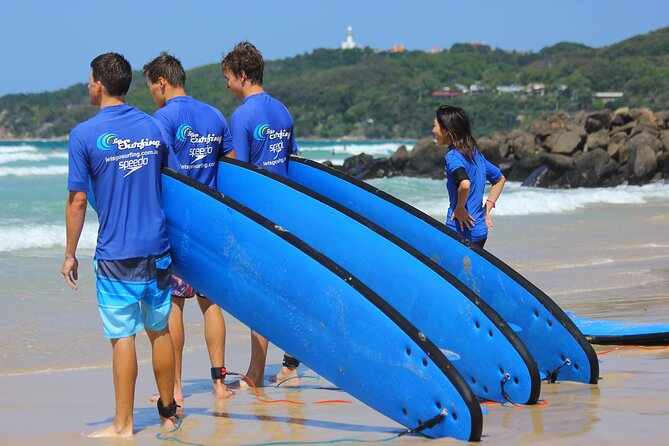
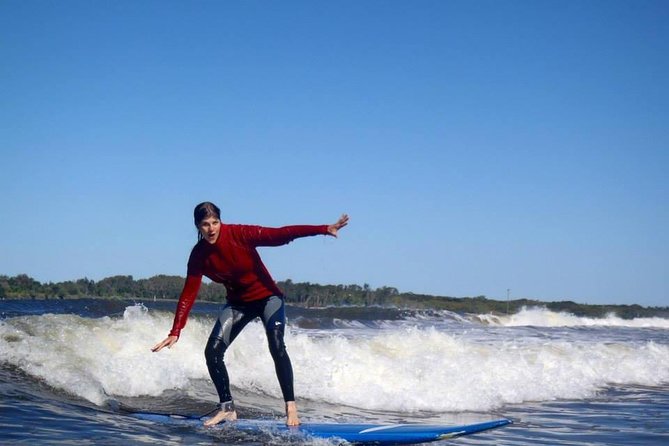
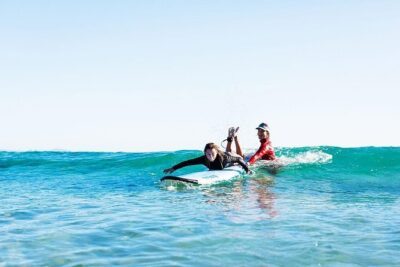
The final stage moves into the surf. You use the supplied board and work on catching suitable waves under instructor guidance. The exact number of attempts will depend on the sea, the group, and how quickly you get comfortable with the board.
The conditions can change the character of the lesson. On one day, the waves were described as small and suitable for beginners. On another, the surf was rougher, but the instructor continued to give guidance and checked that people felt comfortable. That is an important distinction: a good lesson is not defined only by how many times you stand up.
Mitch was praised for helping students into waves, which points to the practical support you can receive in the water. Instructors may help you choose a wave or give you a push at the right moment, but you still need to follow instructions and manage your own balance.
Some people do stand up during their first session. One beginner reported doing so on the first lesson, and another parent appreciated the instructor making sure her daughter got a good wave. I would treat that as an encouraging possibility, not a promise. Surfing asks for timing, balance, and a little luck with the wave.
What the small-group ratio really means
The listed limit is six students for each instructor, with a maximum of 10 people on the activity. That is smaller than a large beach class, but it is not a private lesson.
The ratio matters most once you are in the water. An instructor cannot give constant one-to-one attention to six students at once, yet six is still a manageable number for basic correction and safety guidance. An earlier booking caused confusion because one person expected a smaller group. The operator clarified that the session had two instructors and that the intended limit was six students per instructor.
If personal coaching is your top priority, ask about the group arrangement before booking. Private lessons are available in some circumstances, as shown by a session taken by a parent and son with Blake, but a private option is not part of the standard experience described here.
For most first-timers, the small-group setup offers a reasonable balance. You get the social feel of learning with other people, while the instructor ratio avoids the impersonal feel of a very large class.
Equipment, comfort, and what you need to bring
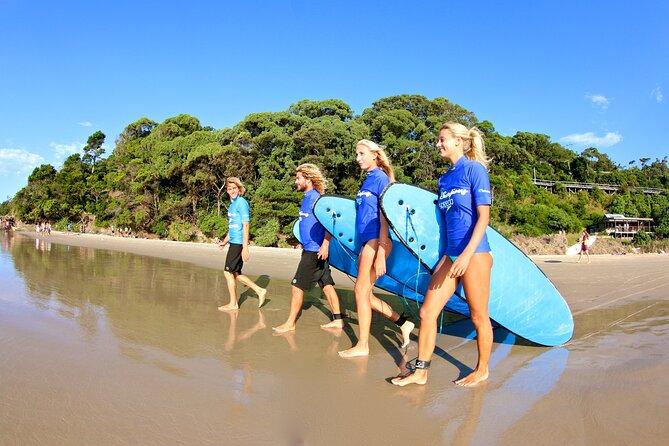
The price includes use of a surfboard, wetsuit, rash vest, and sunscreen. That makes the $63.83 cost easier to assess, since the main activity gear is already covered.
The equipment also removes a common barrier for visitors. You do not need to buy a board, work out which size suits a beginner, or arrange a separate wetsuit rental. The instructor can provide the board used for the lesson and guide you through the basic handling.
You still need to arrive ready to change into the supplied gear. Swimmers are not included, and you should think about what you want to wear or carry after the lesson. Snacks are also excluded. Since the session lasts about two hours and includes physical effort, a snack afterward may be useful.
Sunscreen is supplied, but you should not treat that as a reason to skip sun protection before leaving your accommodation. The experience takes place outdoors, and the early preparation includes applying sunscreen.
Is $63.83 good value?

At $63.83 per person, the price is fair for a two-hour beginner lesson that includes an instructor and the main equipment. You are paying for more than time on a board. The price also covers the use of a wetsuit and rash vest, the coaching, the warm-up, and the transition from beach practice to water work.
The value is strongest if you have never surfed and would otherwise need to hire equipment or learn by trial and error. A first session with an instructor can help you avoid wasting the morning struggling with the wrong board or poor technique.
The value is less obvious if you already surf confidently and only want beach access. In that case, you may not need a full introductory lesson. But if you want to brush up on technique, the instruction can still be worthwhile, especially when the conditions are less forgiving.
The price does not include transport from your hotel or food. Those are small costs compared with the lesson itself, but they matter when you are building a day-by-day holiday budget.
Who will get the most from this lesson?
I would choose this experience if you have always wanted to try surfing but do not want to organise the equipment or work out the basics alone. It also suits someone who has tried before and wants a guided refresher in a relaxed setting.
It is a good match for people who enjoy active sightseeing. You get time at one of Byron Bay’s beaches and a practical activity rather than another lookout or walking tour. The lesson also leaves you with a skill you can continue practising later.
The experience is likely to suit most people because the additional information says most participants can take part. Still, surfing requires physical effort, balance, and comfort in the water. The supplied details do not give specific age, swimming, or fitness requirements, so contact the operator if those questions affect your booking.
Families may find the format useful, particularly when an instructor gives close attention to an individual student. A parent and daughter had a positive session with an instructor who made sure the daughter caught a good wave. That does not guarantee the same result for every family, but it shows how personal the coaching can feel when the group is small.
Weather, surf conditions, and cancellation
The sea is part of the experience, so weather can affect the lesson. A small, beginner-friendly wave makes it easier to practise, while rougher surf may mean more effort and fewer clean attempts.
The operator can cancel if the weather is poor or if the minimum number of participants is not met. In those cases, you are offered another date or experience, or a full refund. You can also cancel for a full refund if you do so at least 24 hours before the start time.
Changes or cancellations made less than 24 hours before the start are not accepted for a refund. The cut-off uses Byron Bay local time. I would avoid booking this as a tightly timed activity immediately before an important departure, since the conditions are outside your control.
My call: book it if you want a proper first lesson
I would book this lesson if you want a practical introduction to surfing in Byron Bay, especially if you value included equipment and a patient instructor more than a guaranteed stand-up moment. The strongest points are the calm Main Beach setting, the two-hour format, and the maximum of six students per instructor.
Before paying, make sure the group ratio suits you and leave room in your schedule for weather changes. Arrive 20 minutes early, bring your swimmers, and expect to work hard rather than simply pose with a board.
For a first surf lesson at a reasonable price, this is a sensible choice. The waves may not cooperate perfectly, but the structure and instructor support give you a good chance to learn something useful and enjoy the attempt.
FAQ
Where does the surfing lesson begin?
The lesson begins at 5/11 Fletcher St, Byron Bay NSW 2481, Australia.
Where does the experience end?
The activity ends back at the meeting point on Fletcher Street.
How early should I arrive?
You should check in 20 minutes before the lesson starts.
How long does the lesson last?
The lesson lasts about two hours.
What equipment is included?
Use of a surfboard, wetsuit, rash vest, and sunscreen is included.
Is an instructor included?
Yes. A professional instructor leads the lesson.
How large is the group?
The stated limit is six students per instructor, and the total activity has a maximum of 10 participants.
Is hotel pickup included?
No. Hotel pickup and drop-off are not included.
Are snacks included?
No. Snacks are not included.
Can I cancel for a full refund?
Yes. You can cancel at least 24 hours before the start time for a full refund. Cancellations made less than 24 hours before the start are not refunded.
What happens if bad weather cancels the lesson?
You will be offered a different date or a full refund if the experience is canceled because of poor weather.
Just added for surfers in Australia
- Surf, Stay and Yoga in Byron Bay 2 day 2 night★ 5.0 · 10 reviews
- Gold Coast: 2-Hour Private Surf Lesson with Photo Package★ 4.8 · 31 reviews
- Learn to Surf Day Trip – Sydney★ 4.5 · 56 reviews
- Learn to Surf at Middleton Beach★ 5.0 · 57 reviews
- Coolangatta: 2 Hour Surf Experience on the Gold Coast★ 4.9 · 58 reviews
- 2-Night Byron Bay Surf Camp★ 5.0 · 68 reviews
- Style Surfing Byron Bay★ 5.0 · 66 reviews
- Private Surf Lessons Kool Katz 1 Day★ 4.5 · 70 reviews
Byron Bay Surf Lessons, compared.

Browse the lists this tour appears in