
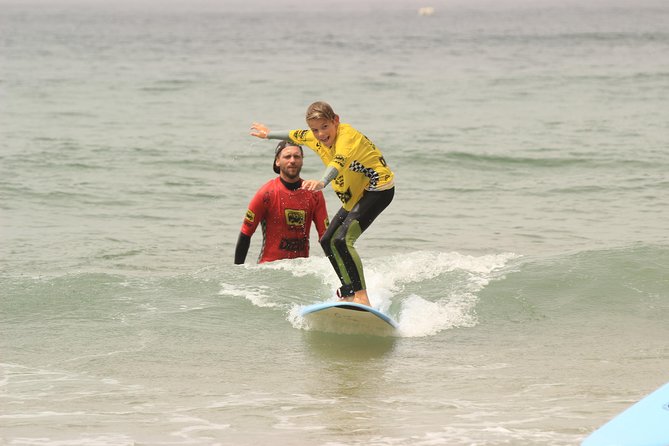
Review · PORTIMAO
Surf Lesson 2H
Praia da Arrifana is the real star here. In two focused hours, you learn how to handle a surfboard, read the sea, paddle, and attempt your first stand-up under the eye of a certified teacher. Land practice comes first, which makes the first minutes in the water less confusing.
I like the small maximum group of five, since an instructor can watch your stance and timing instead of losing you in a crowd. I also like that the lesson covers ocean reading and safe ways to reach the break, not just the glamorous moment of standing up. The main drawback is the short format: two hours is enough for an introduction, but not enough to turn a complete beginner into a polished surfer.
Key points to know before booking
- Praia da Arrifana is the meeting point: The activity begins and ends at this beach, even though the general location is listed as Portimao.
- Built for true beginners: The lesson is aimed at people who have never surfed or who rarely manage to stand on the board.
- Practice happens on land first: You learn body position, paddling, and the take-off before handling the waves.
- Safety is part of the lesson: Board handling in white water, ocean reading, and reaching the point break are all included.
- Small groups help: No more than five people take part, giving the teaching a personal feel.
- Several instructors are named: Pedro, Manuel, and Peste are associated with especially positive teaching experiences.
Starting at Praia da Arrifana
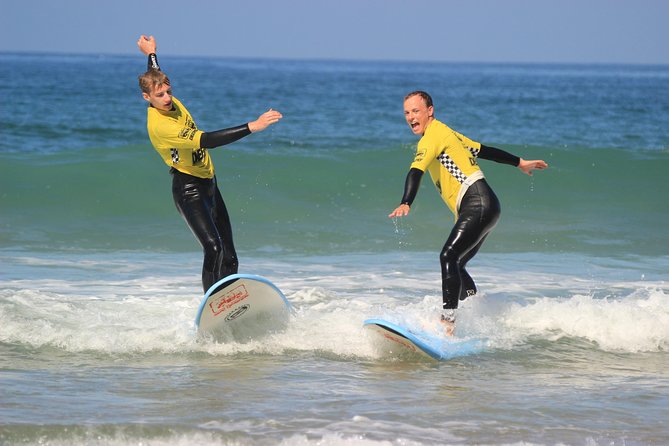
Your lesson begins at Praia da Arrifana and finishes at the same meeting point. That simple setup matters. You do not need to follow a guide through several stops or worry about ending somewhere unfamiliar after spending time in the water.
The booking information places the experience in Portimao, but the specific start point is Praia da Arrifana. Check your route carefully before setting off, especially if you are staying elsewhere in the Algarve. The meeting point is described as convenient and easy to find, and it is near public transportation.
The operating hours listed are 8:00 in the morning until 6:30 in the evening, Monday through Sunday. Your exact lesson time comes from your booking, and surf conditions can make the timing of a beach lesson especially important. A morning or afternoon session can feel very different depending on the waves, wind, and tide, but no exact tide schedule is provided here.
Arrifana is a good setting for a first lesson because the focus stays on the basics rather than on a long sightseeing program. You are there to learn the board, understand the water, and give surfing a fair first try.
More Two-Hour Experiences in Portugal:
- Albufeira: 2-Hour Falesia Beach Surf Lesson
★ 4.8 · 464 reviews - 2-Hour Surf Lesson in Alentejo
★ 5.0 · 243 reviews - Algarve: 2-Hour Beginner Surf Lesson
★ 4.8 · 192 reviews
The first lesson happens on the sand
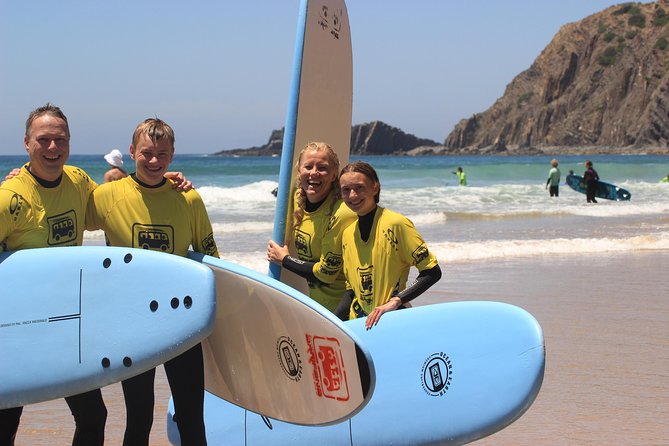
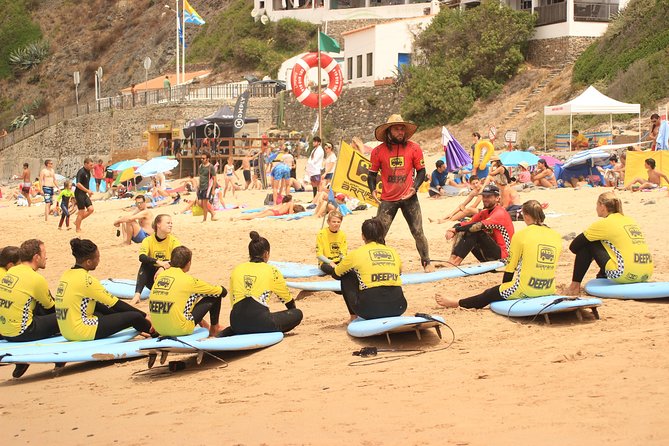
Before you enter the sea, the instructor introduces the equipment and explains the basic safety rules. This is not wasted time. For a beginner, a surfboard can feel awkward and surprisingly powerful in moving water, so learning how to carry and control it is an important first step.
You also learn about the board’s composition. That may sound technical, but it helps you understand how to treat the equipment and why certain handling rules matter. You are shown how to safely manage the board in white water, where a loose board can become a hazard.
Next comes body position. You practice how to lie on the board, where to sit, and how to keep your weight balanced. These details decide whether the board glides smoothly or wobbles as soon as a wave reaches you.
The take-off is the move most beginners picture when they think of surfing. Here, you work through it on land before trying it in the sea. You learn where to place your hands, how to bring your feet underneath you, and how to rise at the right moment.
The lesson also covers timing. Standing up too early, too late, or with your weight in the wrong place can turn a promising wave into a quick swim. Practicing the sequence on land gives you a simple routine to repeat once the water gets busy.
I appreciate this step-by-step approach because it gives you something useful to focus on. You are not merely told to paddle and stand. You learn the motions in a calm setting, then try to apply them in the waves.
Learning to read the ocean
The most valuable part of the lesson may be the attention given to the sea itself. You are taught how waves develop, how to read the water, and how to respect ocean conditions. That knowledge remains useful long after this two-hour session ends.
The instructors explain the position of the line-up, meaning the area where surfers wait for waves. You learn where to sit, how to understand the flow of the water, and how to avoid putting yourself or another surfer in a risky position.
You also learn techniques for reaching the point break with less effort. This is important because beginners often spend too much energy fighting through white water. If you can reach the right area safely and preserve your strength, you have more energy left for paddling and attempting a take-off.
The lesson treats ocean awareness as a basic surfing skill, not an optional extra. That is good teaching. A person who can stand briefly but does not know how to handle a board, read waves, or move through white water is not ready to surf independently.
Conditions are never fully predictable, and the supplied information does not promise a certain wave size or a guaranteed stand-up. You should see the lesson as guided practice. The instructor can teach technique and safety, but the ocean decides how many good chances you receive during the session.
What the two-hour session can cover
Two hours sounds generous when you are booking, but the time passes quickly. A likely progression begins with equipment and safety, continues with body position and paddling, and then moves into the water for attempts at catching waves and standing up.
The exact balance depends on your group and the conditions. A person with no surf experience needs more time for the land drills. Someone who has tried before but cannot stand consistently may move through the first section more quickly and spend more time correcting technique in the water.
The lesson is designed for people who have never surfed or who cannot complete a take-off on most attempts. That makes it a better match for first-timers than for experienced surfers seeking advanced coaching.
The activity also says it caters to all levels and physical abilities, while the detailed level description focuses on beginners. Most people can participate, but you should still consider your own comfort in the ocean and ability to follow physical instructions. The available information does not give a separate fitness standard or a detailed accessibility assessment.
Equipment is provided, and safety is treated as a priority. The practical benefit is clear: you do not need to purchase or arrange a surfboard for this introductory session. The information does not specify every item supplied, so confirm any personal clothing or beach requirements before you go.
More Surf Lessons in Portugal:
- Matosinhos: Surfing Lesson with Equipment
★ 4.8 · 926 reviews - Lisbon Surf Experience
★ 4.9 · 876 reviews - Albufeira: Surf Lesson
★ 4.7 · 699 reviews - Porto: Small Group Surf Lesson with Transportation
★ 4.9 · 594 reviews
Small-group instruction with Pedro, Manuel, and Peste
The maximum group size is five. That is one of the strongest features of the lesson. With only a few people in the water, the teacher has a better chance of noticing whether you are paddling straight, placing your hands correctly, or trying to stand too soon.
The teaching team includes Pedro, Manuel, and Peste. One account of the lesson credits Peste with teaching the basics clearly in a short time. Another describes a session with Pedro and Manuel as both enjoyable and effective, with the students catching waves on their own the following day.
That second detail is worth putting in perspective. Catching waves the next day suggests that the instruction can give beginners a useful starting pattern, but it is not a promise that every person will reach the same point. Surfing progress depends on the sea, your balance, your timing, and how much practice you get.
What I like here is the emphasis on teaching rather than simply handing you equipment. The instructors explain the reasoning behind each motion and connect technique to safety. For a first beach lesson, that is more useful than a quick demonstration followed by a long stretch of unsupported practice.
The water work: paddling, white water, and take-off
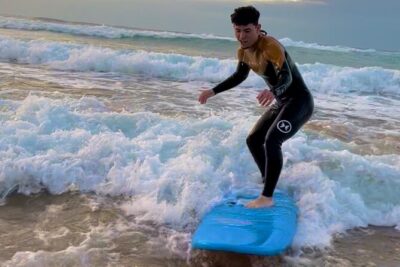
Once you move into the sea, the dry-land exercises become practical. You work on paddling so you can catch a wave, then learn how to manage the board as white water approaches.
The first attempts may take place in broken waves, where the foam has already formed. That gives you a chance to feel how the board moves without immediately dealing with the full force and timing of an unbroken wave. The supplied details do not specify the exact water area used, so the instructor’s judgment and the conditions on the day will shape this part of the session.
You practice timing your take-off. The goal is not simply to stand at any moment. You need to catch the wave with enough speed, place your body well, and rise while the board is moving forward.
This is where a small group can help. You may have time to attempt a wave, listen to a correction, and try again. A two-hour session cannot guarantee repeated turns for everyone, but a five-person limit gives the lesson a better chance of staying active.
Do not expect every attempt to work. Falling is part of learning to surf, and the useful question is whether you understand why the attempt failed. A good correction about paddle speed, hand position, or timing can matter more than one lucky ride.
Why the safety teaching matters
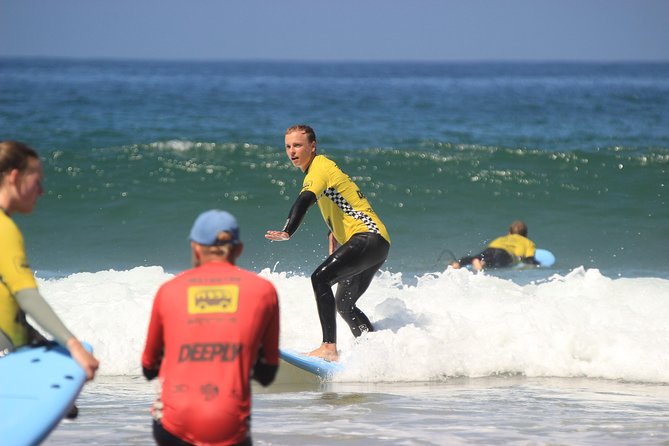
Surfing looks simple from the beach. In practice, you manage a board, moving water, other people, and your own balance at the same time. The safety instruction gives you a way to approach that mix without treating the ocean casually.
You learn how to handle the board in white water and how to reach the point break with less strain. You also learn about the line-up and the need to respect the sea. These lessons help prevent the common beginner mistake of focusing so hard on standing that you forget where the board is or who is nearby.
The activity places ocean reading at the center of the learning process. That is a sensible priority. Surfing skill grows from understanding conditions, not just from repeating a gymnastic movement on the board.
You should still listen closely and follow the instructor’s directions. The lesson provides a safer learning environment, but no beach activity is without risk. The information confirms that safety rules are taught and equipment is supplied, but it does not list medical support, weather guarantees, or a detailed emergency plan.
Is $67.92 a fair price?
At $67.92 per person, this is not the cheapest way to spend two hours at the beach. The value depends on how much you want structured instruction rather than a casual attempt with rented equipment.
You are paying for certified teachers, equipment, safety instruction, land practice, water coaching, and a small group capped at five people. For a complete beginner, those elements make the price easier to justify. The instructor can correct mistakes early, which may save you from building bad habits or wasting your first session guessing what to do.
The value is also stronger if you plan to surf again. Learning how to paddle, read the ocean, manage white water, and reach the break gives you a foundation that extends beyond one lesson. If you only want to stand once for a photograph, the cost may feel higher, especially if the waves are not cooperative.
The lesson lasts about two hours, so calculate the price as an introductory coaching session rather than a full-day activity. It is a focused first step, not an all-day surf camp.
Who will get the most from this lesson?
I would choose this experience if you have never surfed, feel unsure about the ocean, or have tried before but rarely manage to stand up. The lesson is built around that exact stage.
It also suits people who prefer a teacher-led introduction. You are not left to work out the board, line-up, and take-off alone. The land practice gives you a clear sequence before you enter the water.
The activity may fit families or mixed-ability groups because it is described as suitable for all levels and physical abilities, but the available information does not set a minimum age or explain specific mobility accommodations. Ask the provider if either point matters for your group.
More experienced surfers may find the content too basic. The session covers elementary surfing theory and practice, so it is not presented as a lesson on advanced turns, powerful waves, or competition technique.
Booking details worth checking
Confirmation is normally received at booking. If you book within 12 hours of the start time, confirmation comes as soon as possible and depends on availability. That makes an early reservation the safer choice, especially since the activity is often booked well ahead of time.
The listed booking pattern averages 39 days in advance. You do not have to copy that timing, but it suggests that popular dates can fill before your trip.
You can cancel for a full refund up to 24 hours before the start time. Cancellations or changes made inside that 24-hour window are not accepted for a refund, and the cut-off uses local time. Keep that rule in mind when planning around weather or transport.
The mobile ticket is convenient. The meeting point is near public transportation, but the information does not provide a detailed route from Portimao, so check your journey to Praia da Arrifana rather than relying only on the broader location label.
Should you book the Praia da Arrifana surf lesson?
Book it if you want a serious first introduction, a certified instructor, supplied equipment, and a small group. The strongest reasons are the land-based practice, the safety guidance, and the chance to work with instructors such as Pedro, Manuel, or Peste.
Do not book it expecting guaranteed waves, a full day of coaching, or advanced surf technique. Two hours gives you a useful start, and the positive teaching accounts suggest that some beginners can progress quickly, but your results will depend on conditions and your own timing.
For a first surf lesson in the Portimao area, I think the format offers solid value. Just confirm the route to Praia da Arrifana, allow enough time to reach the beach, and approach the session as a foundation for future practice rather than a promise of instant mastery.
FAQ
Where does the surf lesson begin and end?
The lesson begins at Praia da Arrifana, Portugal, and ends back at the same meeting point.
How long does the surf lesson last?
The activity lasts approximately two hours.
Is the lesson suitable for complete beginners?
Yes. It is directed at people who have never surfed or who cannot stand up on a surfboard on most attempts.
What will I learn during the lesson?
You learn safety rules, board composition, safe board handling in white water, body position, sitting and lying on the board, paddling, line-up position, take-off technique, and take-off timing.
Is surf equipment provided?
Yes. The activity includes equipment, with safety listed as a priority.
How many people can join the lesson?
The activity has a maximum of five participants.
Can I cancel for a full refund?
Yes. You can cancel at least 24 hours before the experience start time for a full refund. Cancellations or changes made less than 24 hours before the start time are not accepted for a refund.
Just added for surfers in Portugal
- Tricana Surf Experience★ 5.0 · 3 reviews
- Exclusive Surf Lessons in S Miguel Azores★ 5.0 · 21 reviews
- Guided surf tours from Porto city to the beach★ 4.5 · 10 reviews
- Surfing Lesson | Porto: Small Group Surf Lesson with Transportation★ 5.0 · 34 reviews
- Self-guided tour Bike + Surf★ 5.0 · 6 reviews
- Private Surf Experience – Transfer to Matosinhos – All Levels★ 5.0 · 7 reviews
- Surf Lessons in Porto with transfer at Porto Surf School★ 5.0 · 42 reviews
- Surf Lesson | Surf Lessons★ 5.0 · 39 reviews
Portimao Surf Lessons, compared.


Browse the lists this tour appears in