
Review · MAUI
Surf with ALOHA SURF SCHOOL
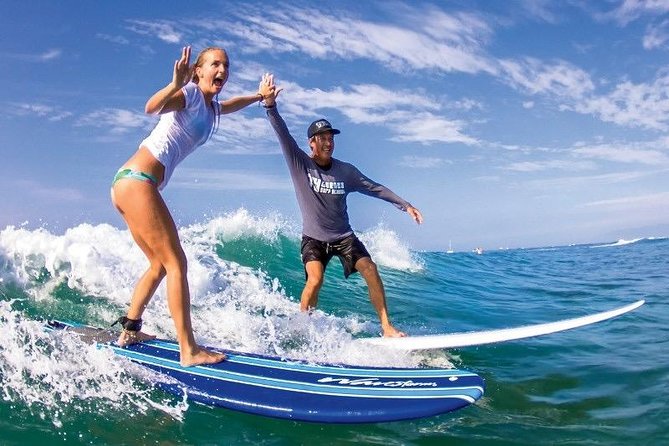
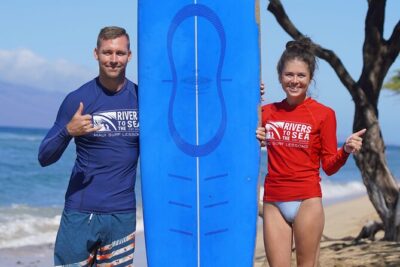
Getting upright on a wave in Maui is a fine way to spend two hours, and Aloha Surf School makes that first attempt feel manageable. You begin with safety and basic technique at Kalama Park, then walk to the surf area with your instructor and equipment. I especially like the small-group format and the patient coaching from instructors such as Sean, Chris, Donald, Jesse, and Kruz.
The lesson includes a board, rash guard, booties, and protective footwear, so you do not need to assemble a pile of gear. The main caution is physical effort: paddling, pushing up, and walking across rocky shallows can tire you quickly. Bring extra sun protection, water, and possibly water shoes.
Key points at a glance
- Beginner-friendly Kalama Park: The gentle water and usually modest surf make this a sensible place for a first lesson.
- Two hours on the water: You have enough time to practice, improve, and try again after an awkward first attempt.
- Patient instructors: Sean, Chris, Donald, Jesse, Chris, Jayden, and other members of the team are praised for clear, calm coaching.
- Small-group attention: The maximum group size is 15, with a more personal feel than a large commercial class.
- Gear is included: You receive a surfboard, rash guard, booties, and protective footwear.
- Plan for real exercise: The session can be tiring, and the shallow water may be rocky.
Your first Maui waves at Kalama Park
Aloha Surf School meets you at Kalama Park, at 1900 South Kihei Road in Kihei. This is both the starting point and the place where the activity ends, which keeps the day simple. You do not have to arrange a separate ride between a shop and the beach.
The setting is well suited to a first lesson. The surf area off Kalama Park, also called The Cove in some descriptions, is known here for gentle conditions and shallow water. That does not mean the session is effortless. You still need to paddle, balance, push up, and carry the board, but you are learning in a place designed to make early success possible.
I like that the activity begins with instruction instead of sending you straight into the water. Your certified instructor covers safety and surfing basics before you walk to the designated surf area. That opening matters. A board can feel unwieldy, and even small waves require you to understand where to sit, how to lie on the board, and how to respond when the wave catches you.
The lesson introduces he’e nalu, the ancient Hawaiian sport of surfing, in a practical way. You are not simply renting a board and hoping to figure it out. An instructor gives you a framework, watches your attempts, and helps you make small corrections.
More Surf Lessons in Maui:
- Maui: Two Hour Beginner Group Surf Lesson in Kihei
★ 5.0 · 950 reviews - Outrageous Surf ScHool Lesson on Lahaina Side
★ 4.5 · 547 reviews - Group Surf Lesson at Kalama Beach in Kihei
★ 5.0 · 264 reviews
What happens during the two-hour lesson
The experience lasts about two hours. Expect the first portion to focus on safety and technique, followed by time in the water. The exact split can change with conditions and the pace of your group, but the goal is clear: get you comfortable enough to catch and ride beginner waves.
You will receive a surfboard and protective gear, including a rash guard, booties, and protective footwear. The rash guard helps protect your skin from rubbing against the board, while the footwear is useful in a shallow area that may have rocky patches.
After the briefing, you walk from the meeting point to the surf area. This short transition is part of the lesson rather than a sightseeing stop. Your instructor can help you manage the board and keep the group together as you approach the water.
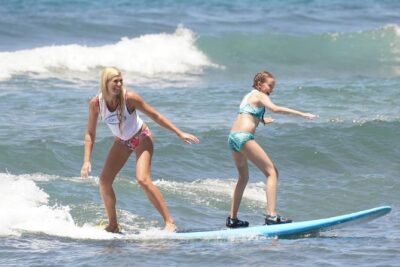
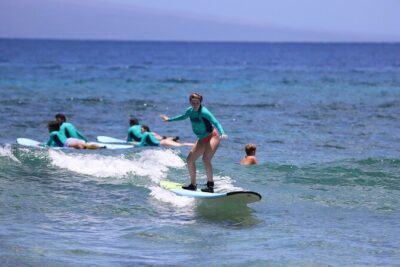
Once you are in, expect repeated attempts. You may begin by practicing your position on the board and learning the motion needed to rise. Then you will try to catch small waves. Some attempts will end with a wobble or a splash. That is normal, and the value of having an instructor nearby is that you can adjust and try again rather than repeat the same mistake.
Several instructors are singled out for making beginners feel at ease. Jesse is described as especially clear and patient, while Donald is praised for helping a nervous first-timer get up on the first wave. Sean is noted for attentive, friendly instruction, and Chris receives strong praise for coaching families and teens for nearly the full session.
The most useful part of this is not a promise that everyone will surf perfectly. It is the steady encouragement that keeps a first attempt from becoming an embarrassing one. If you feel unsure, tell your instructor early. The team has experience helping people who arrive planning to watch from shore and then decide to try.
Why the small-group setup matters
The maximum group size is 15 people, though the experience is presented as a small-group lesson. Group size can shape your day more than the length of the lesson. You want enough individual attention to receive a correction before the next wave, not a long wait while an instructor manages a crowd.
A group of 15 is not a private lesson, so you should keep that distinction in mind. Your time and attention will be shared. Still, the personal coaching described by past participants suggests that instructors work actively with beginners rather than leaving everyone to fend for themselves.
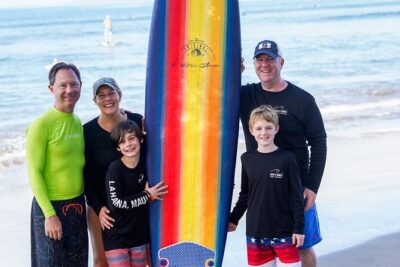
This format works particularly well for families and pairs. One person can be more nervous than another, and a calm instructor can help both find a comfortable pace. Teenagers may want to move quickly, while a parent may need more repetition. The instructors have been praised for handling those differences without making anyone feel behind.
The lesson also seems to have a relaxed tone. Chris and Jayden are praised for being friendly and helpful with people who had only surfed once before. That kind of approach is useful because beginner surfing is physical and slightly awkward. You will get more from the session if you are willing to laugh at the early spills and keep listening.
The instructors make the difference
A surf lesson is only as good as the person giving it. Here, several names come up with specific strengths.
Jesse is praised for clear explanations and patient instruction. That is valuable when you are trying to remember several steps at once. You want directions that are short enough to recall while a wave is approaching.
Donald and his team are credited with making a nervous newcomer feel welcome. Donald also stayed out longer while the participant was having fun. You should not assume every session runs over its stated time, but this gives you a sense of the friendly approach described by the company.
Sean is noted for being attentive, professional, and easygoing, even when the surf was very small. That matters because good conditions for beginners do not always produce dramatic waves. A skilled instructor can help you enjoy the practice itself rather than making the whole lesson depend on a perfect ride.
Chris has worked with families, including teens, and is praised for patient coaching over much of the session. Chris and Jayden have also provided edited ride videos at no extra cost in at least one experience. Photos and videos are mentioned in connection with the instructors, but you should confirm what is offered on your own date rather than count on it as a guaranteed inclusion.
The names and staffing may change. What you can reasonably look for is the teaching style: clear instructions, calm correction, and attention to safety.
Same break, a different way into the water:
- Maui Lahaina Group Surf Lesson
★ 4.9 · 235 reviews - Private Surf Lesson for Two Near Lahaina
★ 5.0 · 189 reviews - 2 Hour Beginner Group Surf Lessons
★ 5.0 · 154 reviews - Group Surf Lessons from Kaanapali Beach
★ 5.0 · 143 reviews
Kalama Park, shallow water, and rocky footing
Kalama Park is a practical meeting point with more around it than just the lesson. It is near public transportation, and the park is suitable for a picnic. Restaurants are nearby, making it possible to turn the surf session into part of a longer morning or afternoon in Kihei.
The water near the lesson area is described as gentle and shallow. That is helpful when you are learning because you can often regain your footing instead of being pushed into deeper water. It also gives instructors a better chance to keep an eye on beginners.
The tradeoff is the bottom. The shallow area can be rocky, and one family found it difficult to watch the children closely from shore. Water shoes are suggested if you plan to enter the water independently or want extra protection around the shallows. The provided booties and protective footwear should help during the lesson, but extra sun and foot protection are still sensible considerations.
Small surf is another mixed point. It may limit the drama of the session, but that is often exactly what a novice needs. You are learning timing and balance, not trying to handle a powerful break. If your main goal is a gentle introduction, modest waves can be an advantage.
How demanding is the activity?
You should arrive with a moderate level of physical fitness. Surfing requires more than standing on a board. You will carry equipment, walk to the water, paddle, push your upper body up, and repeat the process several times.
The session can leave you tired, especially if you are new to exercise in the ocean. One family described the children as happily worn out by the end. That is a good clue for parents: the lesson can be exciting, but it is not a passive beach activity.
Sun protection deserves special attention. Bring extra sunscreen and consider a hat that protects your head when you are on shore. A cap with ultraviolet protection and glasses with a strap are suggested practical additions, though you should confirm that any eyewear is suitable for water use.
Bring water as well. The provided equipment covers the core surf needs, but hydration is your responsibility. If you have concerns about balance, stamina, or getting in and out of shallow water, consider them before booking.
Is $120 a fair price?
The price is $120 per person for roughly two hours. I judge that as a reasonable price for a guided first lesson because it includes the board, rash guard, booties, and protective footwear. You are also paying for instruction, safety guidance, and the convenience of meeting at the beach rather than arranging equipment separately.
The value is strongest if you are a genuine beginner. A rental board alone will not tell you how to position yourself, when to paddle, or how to rise safely. An instructor can help you avoid wasting your session on poor technique.
The price may feel less attractive if you already surf confidently and only need equipment. This is a lesson, not simply a board rental. It makes the most sense for a first-timer, a nervous beginner, or someone who has tried surfing once or twice and wants proper guidance.
The small-group format adds value, though the maximum of 15 means you should not expect uninterrupted one-on-one coaching. If you want a private lesson, ask about that separately. The details provided here support a group activity, not a private booking.
Who will enjoy this lesson most?
I would choose Aloha Surf School for a first Maui surf experience, especially if you want instruction instead of guessing your way through a rental. Families with older children and teens appear to be a strong fit, as do couples where one person is keen and the other is unsure.
The lesson also suits people who want a relaxed introduction rather than an intense surf challenge. Kalama Park’s gentle water and beginner focus favor confidence-building. You can enjoy the setting even if the waves are small.
I would be more cautious if you dislike repetitive physical effort, have trouble with rocky shallows, or want large waves and advanced technique. The point here is to learn basic surfing in manageable conditions. It is not presented as a high-adrenaline session for experienced surfers.
Service animals are allowed, and the activity is near public transportation. Confirmation is provided at booking. Those details help with planning, but you should still consider your own mobility and comfort around water because the activity requires moderate physical fitness.
Booking and cancellation details to know
The experience is offered in English and uses a mobile ticket. It is often booked about 17 days ahead, so reserving early is sensible if your Maui dates are fixed.
You can cancel for a full refund up to 24 hours before the start time. Cancellations or changes made inside that 24-hour window are not accepted for a refund. The cut-off uses local Maui time.
Good weather is required. If poor weather causes the activity to be canceled, you are offered another date or a full refund. That policy gives you some protection, but leave room in your schedule if possible so a weather change does not affect a tightly packed day.
Should you book Aloha Surf School?
Book it if you want a friendly, beginner-focused lesson at a gentle surf spot and value having gear and instruction included. The strongest reasons are the patient coaching, the practical two-hour format, and the chance to learn at Kalama Park without arranging equipment on your own.
I would especially recommend it for families with teens, couples with a nervous first-timer, and people who want to say they surfed in Maui rather than simply watch from shore. Go prepared for exercise, rocky footing, and strong sun. If you do, $120 buys more than a board rental: it buys a supported first attempt, which is exactly what most beginners need.
FAQ
Where does the surf lesson start?
The activity starts at Kalama Park, 1900 South Kihei Road, Kihei, Hawaii 96753.
Where does the activity end?
The activity ends back at the meeting point at Kalama Park.
How long is the surf lesson?
The lesson lasts approximately two hours.
How much does the lesson cost?
The price is $120 per person.
What equipment is included?
The lesson includes a surfboard, rash guard, booties, and protective footwear.
Is the lesson suitable for beginners?
Yes. The lesson covers safety and basic surfing before you walk to the surf area, and the location is described as suitable for first-timers.
How many people can join the activity?
The maximum group size is 15 people.
What language is the lesson offered in?
The activity is offered in English.
Do I need a certain level of fitness?
You should have a moderate level of physical fitness. Surfing involves walking, paddling, balancing, and repeatedly getting up on the board.
What happens if the weather is poor?
If poor weather causes the activity to be canceled, you can choose another date or receive a full refund.
Just added for surfers in Maui
- Private Surf Lessons in Maui★ 5.0 · 2 reviews
- Epic Surf Safari – Best of Maui★ 5.0 · 4 reviews
- Private Surf Lessons in Lahaina, Maui★ 5.0 · 31 reviews
- Semi-Private Surf Lesson at Kalama Beach in Kihei★ 5.0 · 25 reviews
- 2-Hour Semi Private Hawaiian Surf Lesson with the best in Maui..★ 5.0 · 15 reviews
- 2-Hour Surf Lessons with a Pro★ 3.5 · 3 reviews
- Hawaiian-owned and Operated Surf Lessons in Kihei, Maui★ 5.0 · 9 reviews
- Private Surf Lesson at Kalama Beach in Kihei★ 5.0 · 25 reviews
Maui Surf Lessons, compared.

2 Hour Private Group Surf Lesson in Lahaina Maui
Read our review →Browse the lists this tour appears in