
Review · HONOLULU
Hawaii: Electric Hydrofoil Surfing Solo Lesson
The clever part of this Waikiki lesson is that you do not begin by trying to stand on a flying surfboard. You first learn on a balance-board eFoil simulator, then work through belly riding, knee riding, and standing at a pace that makes sense. The board uses a Bluetooth remote, so you control speed instead of waiting for a wave.
I like the step-by-step teaching plan and the constant radio contact with the instructor. I also like that you get a full 60 minutes on the water, not just a quick turn, and that no surf experience is required. The main catch is the $299 price, plus $49 for riders over 200 pounds, so this is a serious splurge for a 90-minute activity.
Key points
- Practice starts on land: A balance-board simulator teaches center of gravity and the three riding positions before you enter the water.
- Three-stage water lesson: Begin on your belly, progress to your knees, then slowly pop up to standing.
- Radio guidance throughout: A radio helmet lets you hear the instructor while you ride.
- Safety is part of the lesson: You receive a life jacket and whistle, plus instruction on emergency stops and falling away from the board.
- Most beginners can make real progress: The operator says all clients have knee surfed and stood during their first lesson, with many eFoiling after 30 to 60 minutes.
- Know the limits: You must be at least 10, comfortable in the water with a life jacket, and within the stated weight limits.
Learning the board before you reach the water
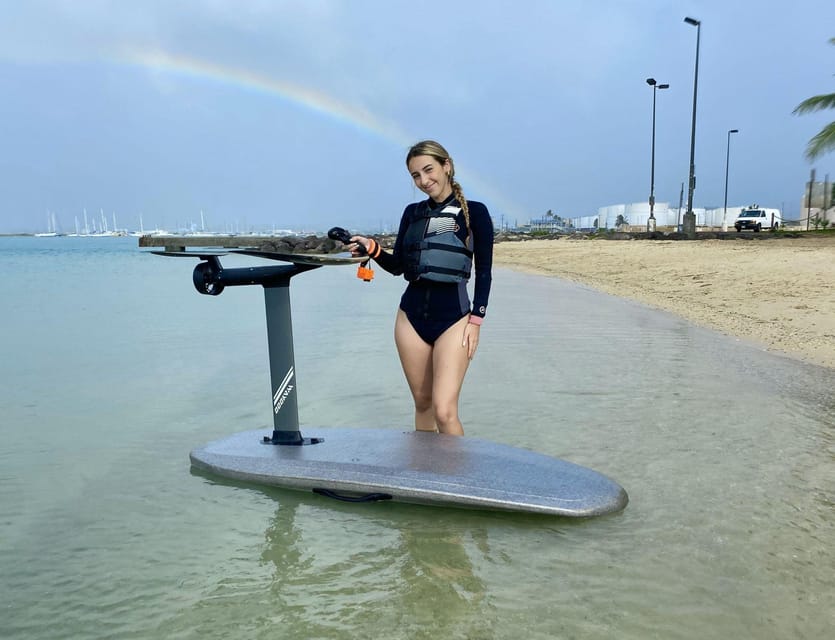
Electric hydrofoiling can look like a strange mix of surfing, flying, and remote-control boating. An electric motor pushes the board forward, while a hydrofoil under the water lifts the board above the surface once you build enough speed and shift your weight correctly.
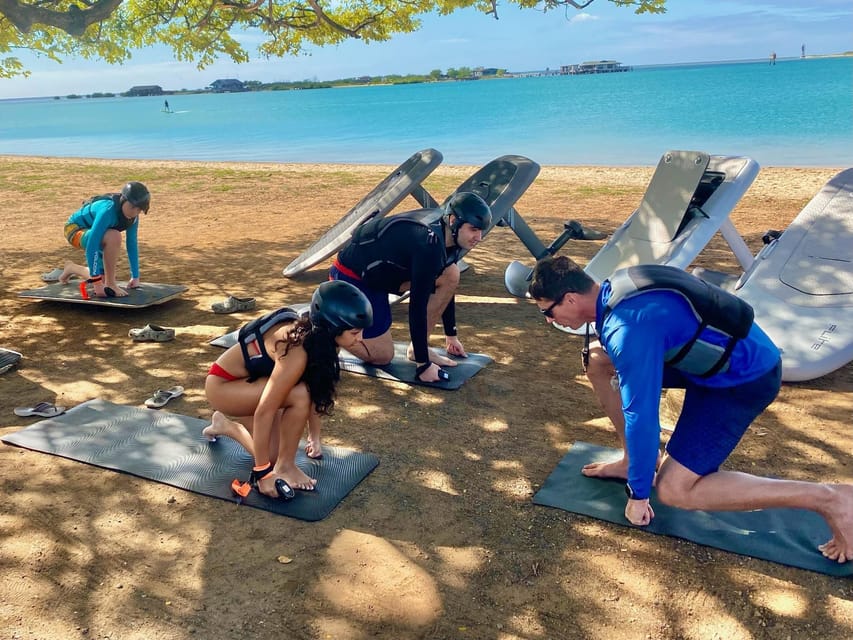
That sounds complicated because it is. The smart choice here is to break the skill into small pieces before adding moving water. Your lesson begins with a land session on a balance-board eFoil simulator. You practice controlling your center of gravity and learn how small body movements affect the board.
You work through three positions:
- Belly down
- Kneeling
- Standing
This order matters. You are not expected to remember the remote, balance the board, manage speed, and stand up all at once. The simulator gives you a place to understand the body position first. I find that especially useful for people who have never surfed or tried a board sport.
You also learn how to operate the Bluetooth eFoil remote on land. The remote controls the board’s speed, so this is not a detail to ignore. You need to know how to accelerate, slow down, turn, and stop before the board starts moving beneath you.
The lesson also covers how to fall safely. You learn to move away from the board if you lose balance rather than landing on it. That instruction is important because the board includes a motor and foil. The safety briefing is not filler before the fun begins. It gives you a plan for the moments when your legs stop cooperating.
More Surf Lessons in the USA:
- Maui: Two Hour Beginner Group Surf Lesson in Kihei
★ 5.0 · 950 reviews - Open Group Surfing Lesson in Waikiki, Hawaii
★ 4.5 · 582 reviews - Outrageous Surf ScHool Lesson on Lahaina Side
★ 4.5 · 547 reviews
Safety gear and radio contact on the water
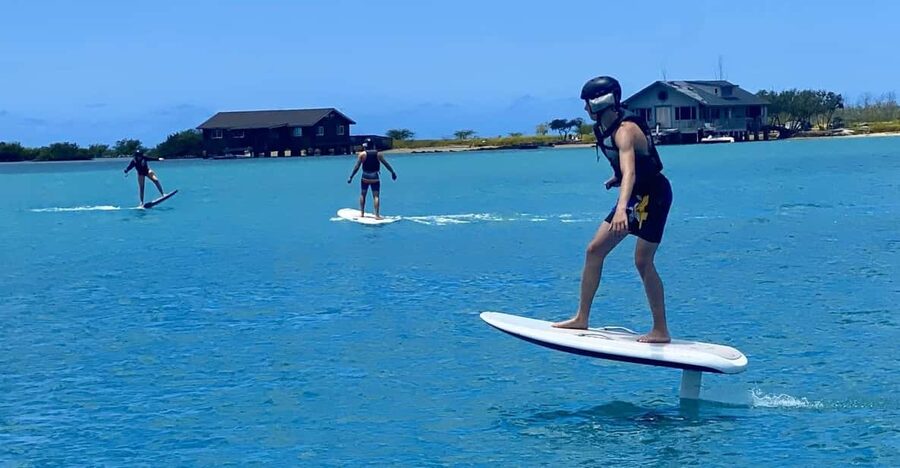
Before the water practice begins, you are fitted with a life jacket and whistle. You should already be comfortable in the water while wearing a life jacket, but you do not need prior surfing experience.
You also wear a radio helmet for constant communication with the instructor. This is one of the more useful parts of the setup. The instructor can give you short corrections while you are riding instead of waiting until you return to shore or paddle back into position.
Expect simple instructions about body position, speed, and weight shift. In a sport where a few inches of movement can decide if the board stays flat or lifts above the water, hearing advice at the right moment can save time.
Bring swimwear, sunscreen, and a hat. Food, drinks, and transportation are not included, so plan those separately. The provided information does not list hotel pickup, so you should arrange your own way to the activity location.
The first water stage: belly rides and remote control
Your water time begins with belly rides. This may sound like the least exciting part, but it gives you a useful first win. You get the board moving while keeping your body low and stable.
At this stage, you practice using the remote, turning the board, and making emergency stops. You are learning to manage speed and direction before adding the harder task of standing. A beginner who rushes this stage can easily focus so much on balance that the remote becomes an afterthought.
The belly position also helps you understand how the board responds. You can feel the difference between slow movement and the speed needed for the foil to work. You also begin learning how much room you need to make a turn.
The instructor guides you through this process by radio. Listen closely and resist the temptation to accelerate simply because the board feels stable. The goal is controlled movement, not maximum speed.
Kneeling brings the board closer to flight
Once you are comfortable with belly riding, you progress to knee riding. This raises your center of gravity and makes your balance more demanding, but it is still much easier than standing.
You practice turns from your knees and begin accelerating toward eFoiling speed. This is where you start to feel the board change under you. The foil needs enough forward motion to lift, but too much speed without control can make the next movement harder.
The instructor’s progression lets you work toward that threshold gradually. You can concentrate on keeping the board pointed in the right direction, using the remote, and shifting your weight without also worrying about your feet.
You practice turns in both directions. That is important because many beginners have one side that feels natural and another that feels awkward. The lesson gives you time to find your proper stance rather than assuming you will instantly know which foot belongs forward.
If you have experience with skateboarding, wakeboarding, snowboarding, or another board sport, you may recognize the value of this section quickly. You already have some sense of balance and stance. Still, board-sport experience is helpful rather than required.
Same break, a different way into the water:
- Los Angeles: Surfing Lesson in Venice Beach
★ 4.8 · 442 reviews - Oahu: Beginner-Friendly Waikiki Beach Surfing Lesson
★ 4.9 · 425 reviews - Po’ipu Surf Lesson
★ 5.0 · 361 reviews - Private Hanalei Sandy Bottom Surf Lesson on Kauai
★ 5.0 · 339 reviews
Standing up slowly, without chasing a wave
The next step is a slow pop-up from your knees to standing. This is different from ordinary surfing. You are not waiting for a wave to push you forward, and you do not need to leap up quickly before the wave passes.
You can take your time. That is one of the friendliest features of this lesson for beginners. The electric motor provides forward motion, so you can focus on the transition itself.
You first find a stable standing position while keeping the board under control. Then you work on turns in both directions and adjust your stance. The instructor can help you make small changes through the radio helmet.
The board will not immediately rise into a smooth flight every time. That is normal. You practice what is described as touch-and-go foiling, allowing the board to lift briefly and settle again. This gives you a clear feel for how your weight affects the foil.
To rise, you slowly shift your center of gravity back. The board then begins to lift out of the water into the eFoiling position. The word slowly is worth remembering. A sudden backward shift can make the board rise too fast or throw off your balance.
I like this teaching method because it treats short flights as useful progress. You do not need to remain above the water for a long run to learn something. Each lift teaches you how the remote, your stance, and your weight work together.
What 60 minutes of water time really means
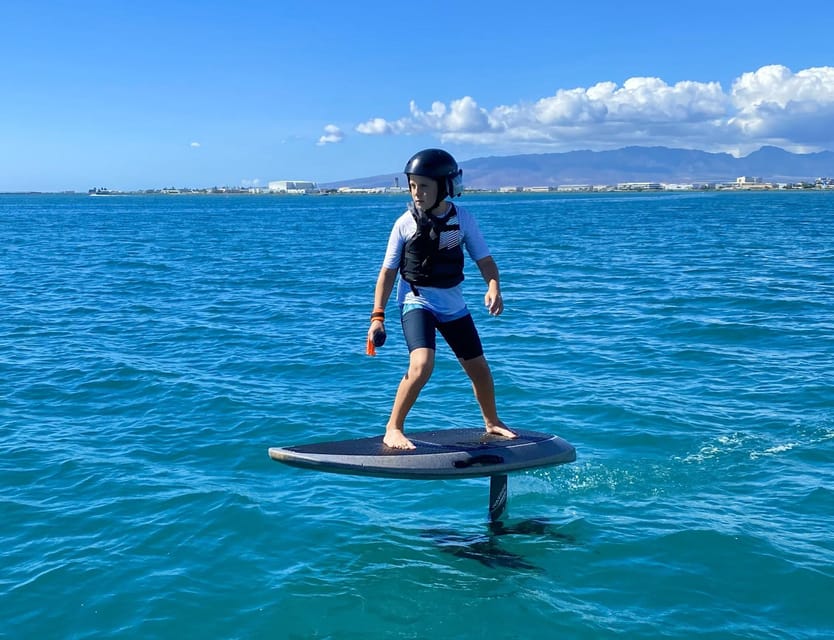
The total activity lasts 90 minutes, including the land lesson and setup. You receive 60 minutes of water time. That is a good amount for a first lesson, especially because the water session includes several stages rather than one long attempt at standing.
Your actual progress will depend on balance, comfort in the water, and how quickly you understand the remote. The operator says all clients have managed to knee surf and stand during their first lesson, and that many students are confidently eFoiling after 30 to 60 minutes.
Treat those figures as a sign of the lesson’s intended progression, not a promise about your exact result. You may stand quickly but need more time to maintain flight. You may also spend much of the water session getting comfortable with turns and speed.
At 90 minutes, this is long enough to learn a real skill but short enough to fit into a busy Hawaii day. It is not a full-day water adventure. You are paying for concentrated instruction and equipment, not a casual rental period.
The private-group format is worth clarifying when you book. The activity is described as a group lesson and also as a private group, so you should confirm the exact group arrangement if personal attention is your top concern. The radio system and structured lesson plan still provide direct instruction during the ride.
The $299 price and what you receive
At $299 per person, this lesson sits firmly in the special-activity category. You are not paying only for time on a board. The price includes the eFoil, remote, safety equipment, radio helmet, instructor guidance, simulator practice, and 60 minutes of water time.
That package has real value if you have wanted to try eFoiling but do not want to figure out the equipment alone. The foil board, Bluetooth remote, and motor are specialized pieces of gear. A mistake with the remote or a poor fall can end the session quickly without proper instruction.
The simulator is another reason the price is easier to understand. You receive a land lesson before using the equipment in the water, which cuts down on unproductive trial and error. The radio helmet also gives you active guidance during the session.
Still, $299 is a lot for a 90-minute experience. If you are unsure about board sports or do not enjoy learning new physical skills, the cost may feel high. You should also budget an additional $49 if you weigh between 201 and 265 pounds. The standard lesson has a 200-pound limit.
The activity does not include transportation, food, or drinks. Those are minor costs compared with the lesson itself, but they matter when you are planning a full day.
Who should book this Hawaii activity
I would point this lesson toward adults and children age 10 or older who are comfortable in the water and curious about a new board sport. You do not need surfing experience, which makes it a better choice than a traditional surf lesson for someone who likes the idea of surfing but does not want to depend on waves.
It also suits you if you enjoy technical activities. The remote, foil, body position, and speed control give you several things to learn at once. People with balance from other board sports may move from eSurfing to eFoiling faster, but the lesson is designed for first-timers too.
The activity is not suitable for pregnant women, people with back problems, or people with mobility impairments. The provider also sets a minimum age of 10 and a standard weight limit of 200 pounds, with an extra-cost option up to 265 pounds.
I would not choose this as a purely relaxing ocean outing. You will be learning, falling, getting back on the board, and repeating movements. It can be fun, but it is active instruction rather than a slow sightseeing cruise.
Small details that make the lesson easier
Wear swimwear that lets you move comfortably. Apply sunscreen before you arrive and bring a hat, though you should make sure it will not interfere with the radio helmet.
Listen carefully during the land session. The balance-board practice may seem less exciting than the water, but it is where you learn the key ideas: center of gravity, stance, remote control, and safe falling.
Keep your first goal modest. Belly riding with a controlled turn is progress. Knee riding with an emergency stop is progress. A brief touch-and-go flight is progress. Trying to force a long standing run can slow you down.
Pay attention to both turning directions. You may naturally favor one side, but the lesson includes practice in both directions so you can develop a more useful feel for the board.
Finally, be honest about your comfort in the water. A life jacket is included, but you still need to feel at ease wearing one and following instructions while on the board.
Is eFoil Waikiki worth booking?
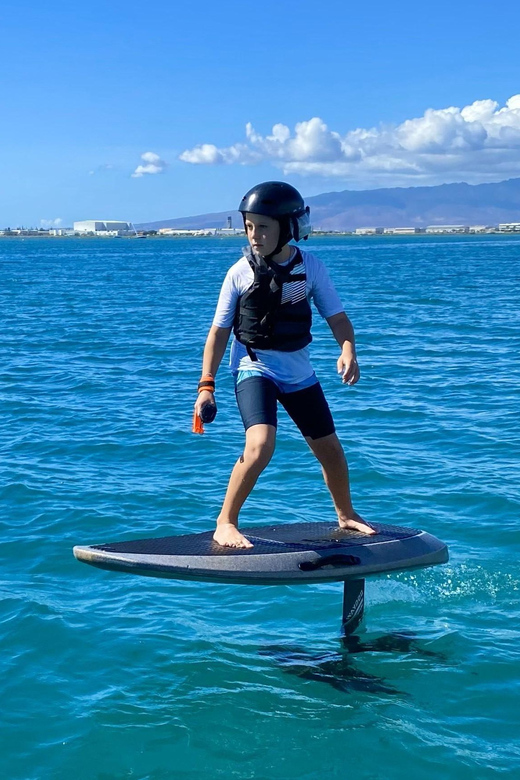
Book this lesson if you want a well-structured first taste of electric hydrofoiling and are willing to pay for instruction, equipment, and a serious attempt at learning. The simulator, staged water practice, radio helmet, and full hour on the water give you more support than a simple board rental.
The price is harder to justify if you only want a quick novelty ride or a quiet ocean activity. You should also check the weight rule before paying and confirm the private-group arrangement if that affects your decision.
For a physically active Hawaii splurge, I think the lesson makes sense. You get a real introduction to the sport, not just a short turn on unfamiliar equipment, and you can progress from belly riding to standing without needing surf experience.
FAQ
How long does the eFoil lesson last?
The activity lasts 90 minutes and includes 60 minutes of water time. The remaining time covers the land lesson, simulator practice, safety information, and preparation.
Do I need surfing experience?
No. Prior surfing experience is not required. Experience with other board sports may help you progress faster.
What positions will I learn?
You learn belly riding, knee riding, and standing. The lesson moves through these positions in stages.
Is safety equipment included?
Yes. The activity includes a life jacket, whistle, radio helmet, and all necessary eFoiling equipment. You also learn how to fall away from the board and how to make emergency stops.
What should I bring?
Bring a hat, swimwear, and sunscreen. Transportation, food, and drinks are not included.
What is the minimum age?
Participants must be at least 10 years old.
Is there a weight limit?
The standard lesson is for participants up to 200 pounds. An additional option is available for people weighing 201 to 265 pounds for an extra $49.
Can I cancel the booking?
Yes. You can cancel up to 24 hours in advance for a full refund. You can also reserve now and pay later, which keeps your plans flexible.
Just added for surfers in the USA
- Waikiki: Family, Private, and Group Surfing Lessons★ 5.0 · 4 reviews
- Waikiki: Surf Lessons Easy 60 min classes no crowds!★ 4.9 · 21 reviews
- Two- Hour Group Surfing Lesson in Cocoa Wrightsville Beach, NC★ 5.0 · 13 reviews
- 1-on-1 Private Surf Lesson in Santa Barbara★ 5.0 · 4 reviews
- Astonishing Scavenger Hunt: Surf, Sand and Sculptures!★ 3.0 · 2 reviews
- Electric Bike Rentals in Topsail Island and Surf City★ 5.0 · 2 reviews
- Surf Lesson in Santa Barbara★ 3.0 · 2 reviews
- Surf lesson with KTO Yoga Surf★ 4.0 · 5 reviews
USA Surf Lessons, compared.


Beginner-Friendly Waikiki Beach Surfing Lesson
Read our review →

Private Hanalei Sandy Bottom Surf Lesson on Kauai
Read our review →
Browse the lists this tour appears in