
Review · SAN FRANCISCO
Private Surf Lessons At Stinson Beach In Marin
Stinson Beach gives you a useful place to learn: a private instructor can focus on your pop-up, wave timing, and comfort in the water instead of running a large class. I like the one-on-one coaching and the chance to ask questions at your own pace. I also like that the lesson covers ocean safety and currents, not just how to stand on a board.
The main catch is cost. The lesson is $225 per person, and equipment rental costs another $35 to $55. The experience is also non-refundable, so check the weather and your schedule carefully before booking.
Key points to know before you book
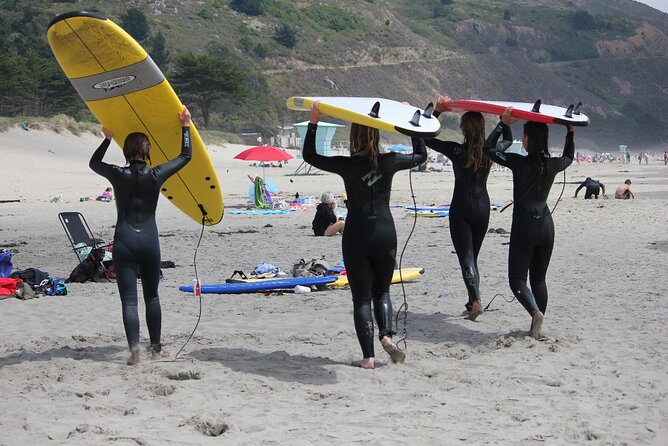
- A true private lesson: Only your group participates, with one to three people included in the standard setup.
- A useful 90-minute format: You cover safety and technique before putting those skills into practice in the water.
- Good for any skill level: Beginners can learn the basics, while returning surfers can work on specific problems.
- Ocean awareness is part of the lesson: Expect instruction about sea currents, the break point, and catching waves.
- Equipment is extra: Budget $35 to $55 per person in addition to the lesson price.
- Stinson Beach meeting point: Start and finish at 3415 CA-1, Stinson Beach, California 94970.
Why private coaching makes a difference at Stinson Beach
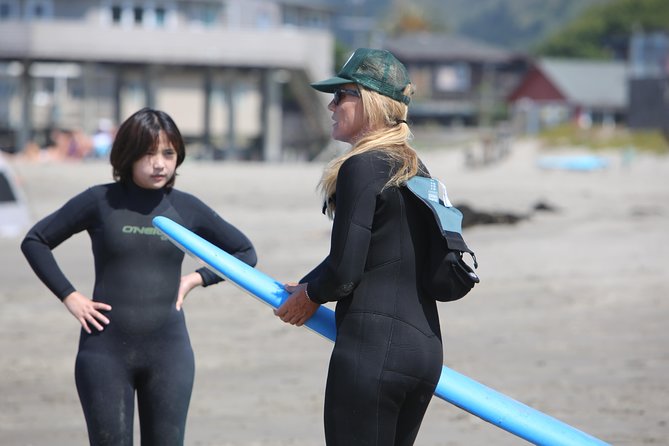
Surfing is a sport where small corrections matter. Your hands may be too far forward, your feet may land unevenly, or you may try to catch a wave too late. In a large class, an instructor cannot watch every attempt closely. Here, the lesson is built around your pace and your questions.
That matters most if you are new to surfing. The supplied details describe instruction that moves from safety and sea currents to the mechanics of getting up on the board and then into water practice. This order makes sense. You need to understand where and when to move before worrying about style.
The private format also works well for a friend, couple, or small family group. One person may need help with balance, while another wants more advice on reading waves. A shared lesson lets you learn together, but the small group keeps the instruction personal.
The standard group size is one to three participants. That is a useful limit. You are not paying for a supposedly private lesson only to find yourself in a crowd. If more than three people join, the additional charge is $70 per person, and you should ask about group rates before booking.
More Private Surf Lessons in the USA
- Private Surf Experience
★ 5.0 · 200 reviews - Private Surf Lesson for Two Near Lahaina
★ 5.0 · 189 reviews - Private Surfing Lessons in Waikiki
★ 5.0 · 176 reviews
The 90-minute lesson, from shore briefing to water practice
The lesson begins at 3415 CA-1 in Stinson Beach. The supplied information does not set out a minute-by-minute schedule, so your exact timing may vary. Still, the structure is clear enough to help you picture the session.
1. Meet your instructor and cover safety
The first part focuses on the basics you need before entering the water. That includes safety information and an introduction to sea currents. This is not filler. Understanding currents helps you make better choices about where to move and when to stop.
If you are a first-time surfer, this part may be the most important lesson of the day. A board is not enough. You also need to understand the water around you and pay attention to the instructor’s directions.
Use this opening to ask direct questions. You can ask about what you find confusing, rather than waiting for a standard group explanation to cover it. That is one of the strongest reasons to choose private instruction.
2. Learn the pop-up on land
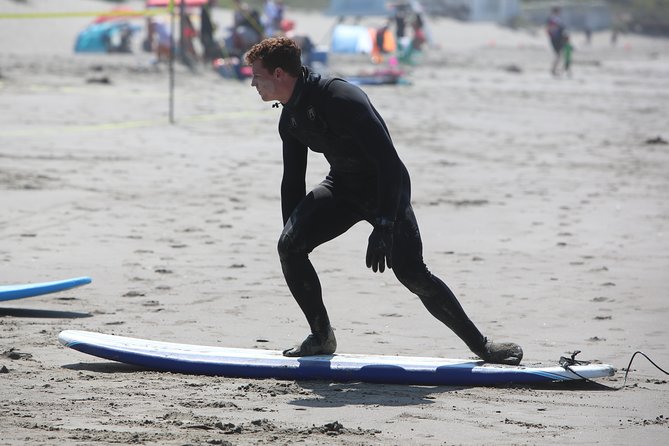
Getting from your stomach to your feet in one quick movement is the basic surf skill. You can expect instruction on how to pop up on the board before practicing in the sea.
A good private lesson gives you a chance to repeat the movement and correct it. If your feet land in the wrong place or you lose your balance, the instructor can focus on that exact problem. You are not simply watching someone else demonstrate and then hoping you copied it correctly.
For beginners, this is where the lesson can feel most encouraging. You do not need perfect form on your first attempt. You need a clear method, a safe place to practice, and an instructor willing to explain the movement again.
Same break, a different way into the water:
- Maui: Two Hour Beginner Group Surf Lesson in Kihei
★ 5.0 · 950 reviews - Open Group Surfing Lesson in Waikiki, Hawaii
★ 4.5 · 582 reviews - Outrageous Surf ScHool Lesson on Lahaina Side
★ 4.5 · 547 reviews - Los Angeles: Surfing Lesson in Venice Beach
★ 4.8 · 442 reviews
3. Move into the water and work on waves
The final part puts the earlier instruction to use. You practice in the sea, work on finding the break point, and try to catch waves. These are practical skills that require timing, not just strength.
The available feedback describes a beginner learning to identify the break point and catch waves independently after the session. That gives you a useful idea of the lesson’s aim. You are not simply pushed into the water for a quick thrill. You are taught how to make decisions for yourself.
Your results will depend on the conditions, your fitness, and how quickly you take to the board. No short lesson can promise that you will become a strong surfer in one morning. It can give you a foundation and help you understand what to practice next.
What the private format feels like for different skill levels
If you are a complete beginner
This is probably the clearest match for the lesson. You can ask basic questions without worrying that you are slowing down a large class. The instruction includes safety, currents, the pop-up, and wave practice, which gives you a sensible introduction to the sport.
I would pay close attention during the safety section. It is easy to focus on standing up and forget that reading the water is part of surfing. The lesson is more useful if you leave knowing not only how to get on the board, but also how to think about the waves.
If you have surfed before
The lesson can also suit someone who already knows the basics but wants to improve. You can use the private time to ask about a specific problem, such as catching waves, finding the break point, or getting a cleaner pop-up.
The value depends on how clearly you explain your goal. Tell the instructor what you want to work on at the start. Private time is most useful when it is shaped around a real question rather than left as a general introduction.
If you are booking for a small group
One to three people is the most practical group size. You can share the activity with friends or family while still keeping the lesson close to each participant.
Remember that people in the same group may have different abilities. A beginner and a more experienced surfer can both benefit, but they may need different advice. Mention this when you book so the session can be planned around your group.
The real value of $225 per person
The listed price is $225 per person for about 90 minutes. That is a high cost for a short activity, especially once you add the $35 to $55 equipment rental. For one person, the total can reach approximately $260 to $280 before any other personal expenses.
The price makes more sense if you value focused instruction. You are not paying only for time on a board. You are paying for a private lesson that covers ocean safety, currents, technique, and practical wave work. If a larger class would leave you waiting for help, private coaching may save frustration and give you more useful practice.
The format is also easier to justify for a small group. You can share the setting with one or two other people while keeping the session private to your party. Still, the pricing details should be clear before you commit. The standard setup covers one to three participants, and each person needs to account for the additional equipment charge.
Ask what the equipment rental includes when you book. The supplied information gives the price range but does not spell out the exact items. That simple question will help you calculate the true cost and avoid surprises at the meeting point.
Stinson Beach logistics and what to plan for
You meet at 3415 CA-1, Stinson Beach, California 94970. The activity ends back at the same meeting point, so you do not need to arrange a separate pickup location afterward.
The experience is offered in English. A mobile ticket is available, and confirmation is provided at booking. The meeting point is near public transportation, which may help if you are not driving, though the details do not specify which service or route to use.
Plan to arrive ready for an outdoor activity and allow enough time to find the meeting point. The session lasts about 1 hour and 30 minutes, but the practical part of your day includes getting to Stinson Beach and dealing with equipment rental.
The beach setting is a major part of the appeal, but it also means conditions matter. This activity requires good weather. If poor weather causes a cancellation, you will be offered another date or a full refund.
There is also a minimum number of participants required for the activity to run. If the provider cancels because that minimum is not met, you can choose a different date or experience, or receive a full refund. That protection applies to provider cancellations, not to a change of your own plans.
Equipment costs and comfort in the water
Equipment rental is not included. The extra cost is listed as $35 to $55, so treat it as part of the basic budget rather than an optional surprise.
The information provided does not specify the individual rental items. Ask before booking whether the rental covers everything you need for the lesson or if any part is separate. This is especially important if you already own some surf equipment and want to bring it.
Your comfort level also matters. Most people can participate, and service animals are allowed. The activity is still a physical water lesson, so you should be ready to follow safety instructions and take guidance from the instructor.
I would not choose this lesson for someone who wants a passive beach outing. You will be practicing movements, working with a board, and entering the sea. It suits an active participant who wants to learn by doing.
What the instruction should help you take home
The best result from a short surf lesson is not simply one successful ride. It is leaving with a few repeatable skills.
You should aim to understand:
- How to approach the board and prepare for a pop-up
- How to move from lying down to standing
- How to identify the break point
- How to judge when a wave is ready to catch
- How currents affect your position
- How to continue practicing safely after the lesson
The experience is particularly useful if the instructor helps you connect these pieces. A pop-up without wave timing will not get you far. Wave timing without attention to currents can create problems. The lesson’s strongest feature is the way those topics are presented together.
Private coaching also gives you a chance to repeat what you find hard. That can make the difference between remembering a demonstration and actually using the skill yourself.
The main drawbacks to consider
The price is the first concern. At $225 per person, plus equipment rental, this is not a casual try-it-and-see activity for most budgets. You are paying for personal instruction, so the value is strongest if you plan to practice afterward or have a clear surfing goal.
The non-refundable policy is another serious point. You cannot change or cancel the booking for a refund. Bad weather or a failure to meet the minimum participant requirement are exceptions because the provider may offer a new date, another experience, or a full refund.
The lesson is also short. Ninety minutes is enough for an introduction and practical work, but not enough to cover every part of surfing. You may leave eager for more instruction, which is a good outcome, but you should not expect a full course in one session.
Finally, the available information does not name the instructor or promise a particular coach. If you are hoping to work with a specific person, ask before booking rather than assuming one will be assigned.
Who should book this Stinson Beach lesson?
I would recommend it to a beginner who wants patient attention and does not want to learn in a large class. It also fits a returning surfer who can name a skill to improve, such as the pop-up or catching waves.
It makes sense for one to three friends who want a private activity and are comfortable sharing the lesson. The extra $70 per person after the third participant means larger groups should request a group rate before paying.
I would hesitate if you are uncertain about your schedule, since the booking is non-refundable. I would also think twice if the full cost feels high for a single 90-minute session. In that case, a less expensive group lesson may offer better value, though it will not provide the same private attention.
Final call: a focused introduction, at a premium price
Book this lesson if you want direct coaching at Stinson Beach, value the chance to ask questions, and plan to use the instruction beyond one afternoon. The combination of safety guidance, current awareness, pop-up practice, and wave timing gives the session more substance than a quick board rental.
Skip it if you want a low-cost beach activity or need flexible cancellation terms. The price is substantial, equipment costs extra, and the booking cannot be changed for personal reasons.
For the right student, this is a practical way to get started or correct a few stubborn habits. Go in with a clear goal, budget for the rental, and treat the safety instruction as part of the lesson, not a delay before the fun begins.
FAQ
Where does the private surf lesson meet?
The meeting point is 3415 CA-1, Stinson Beach, California 94970, USA.
Where does the activity end?
The activity ends back at the meeting point.
How long does the lesson last?
The lesson lasts approximately 1 hour and 30 minutes.
How many people can join the private lesson?
The standard group size is one to three participants. Each additional person after three costs $70, and you can inquire about group rates.
Is surf equipment included?
No. Equipment rental costs an additional $35 to $55.
Is the lesson suitable for beginners?
Yes. The lesson is suitable for all levels and includes safety information, sea currents, pop-up technique, and practice in the water.
What happens if poor weather cancels the lesson?
If poor weather causes a cancellation, you will be offered a different date or a full refund.
Just added for surfers in the USA
- Waikiki: Family, Private, and Group Surfing Lessons★ 5.0 · 4 reviews
- Waikiki: Surf Lessons Easy 60 min classes no crowds!★ 4.9 · 21 reviews
- Two- Hour Group Surfing Lesson in Cocoa Wrightsville Beach, NC★ 5.0 · 13 reviews
- 1-on-1 Private Surf Lesson in Santa Barbara★ 5.0 · 4 reviews
- Astonishing Scavenger Hunt: Surf, Sand and Sculptures!★ 3.0 · 2 reviews
- Electric Bike Rentals in Topsail Island and Surf City★ 5.0 · 2 reviews
- Surf Lesson in Santa Barbara★ 3.0 · 2 reviews
- Surf lesson with KTO Yoga Surf★ 4.0 · 5 reviews
USA Surf Lessons, compared.



Beginner-Friendly Waikiki Beach Surfing Lesson
Read our review →

Private Hanalei Sandy Bottom Surf Lesson on Kauai
Read our review →
Browse the lists this tour appears in