
Review · OAHU
Surf Honolulu: Ala Moana Stand-up Paddleboard Lesson
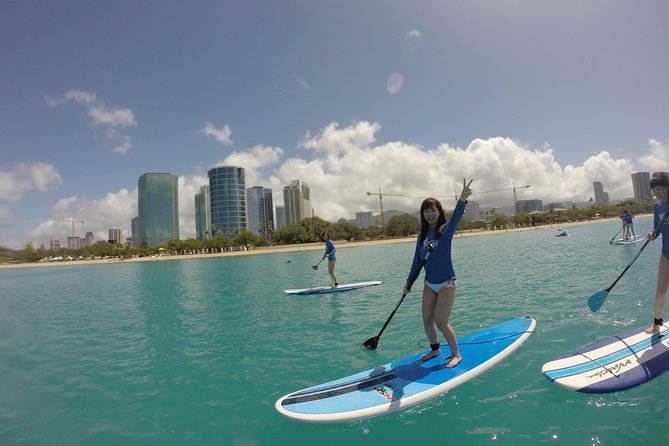
A sea turtle sighting can be a memorable bonus, but the real appeal here is learning SUP in the calm water of Ala Moana Beach. Surf HNL starts with dry-land instruction, then helps you hold the paddle, steer, turn, read the current, and stay upright before sending you farther out.
I like the tiny group size, capped at four, and the choice of a small-group or private lesson. I also like the practical coaching style: Ridge takes you through the moves on shore, while Nate is praised for patient, kind help matched to your comfort level. The main drawback is the price, $139 per person, which may feel high if you only want a quick board rental.
Key points
- Calm Ala Moana water: A sensible setting for learning balance, paddling, and turns.
- Small groups of up to four: More personal help than you usually get in a large beach lesson.
- Dry-land practice first: You learn the basic movements before stepping onto the board.
- Coaching for different skill levels: Choose a small-group or private lesson, with instruction adjusted to your ability.
- Equipment included: Board, paddle, leash, reef shoes, and available rashguards and life jackets are provided.
- Selected Waikiki pickup: Round-trip hotel transport is included from certain Waikiki hotels.
Why Ala Moana is a smart place to learn SUP
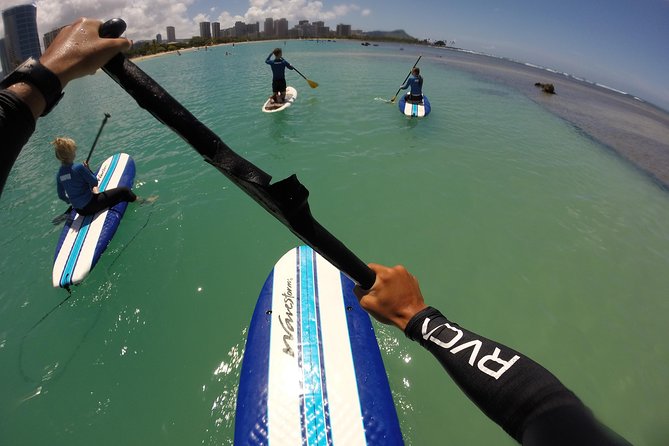
Stand-up paddleboarding looks easy from shore. You stand on a broad board, push a paddle through the water, and glide along. Once your feet are on the board, though, balance, paddle position, current, and steering all matter at once.
Ala Moana Beach Park gives this lesson a useful setting. The instruction begins at the calmest, warmest part of the beach, where you can work on the basics without immediately battling rough conditions. That matters if this is your first time on a paddleboard, or if you have tried before and spent more time falling than moving.
I like that the lesson is not framed as a simple equipment handoff. You are shown how to use the gear and how to control the board. The instructor covers the way to hold the paddle, how to stay upright, how to make turns, and how to read the current. These are small details, but they make the difference between wobbling in place and actually enjoying the sport.
Once you feel ready, you take the board onto flat water. If your balance and confidence improve, you can get more ambitious and try riding waves. The order is sensible: learn control first, then decide how much challenge you want.
More Stand-Up Paddleboarding in Oahu:
- Surf or Kayak or Standup Paddle board in Lanikai, Kailua, Oahu
★ 5.0 · 3 reviews - From Nerja: Guided Paddle Surf Cliffs and Maro Waterfall
★ 4.5 · 400 reviews - Seville: Paddle Surf Route and Class
★ 5.0 · 346 reviews
From Waikiki pickup to Ala Moana Beach Park
If your hotel is among the selected Waikiki properties, the experience begins with round-trip pickup. The ride to Ala Moana Beach is short, so you do not lose much of your morning or afternoon to transportation.
If your hotel is not covered by the pickup service, the stated meeting point is 71 Ala Moana Park Drive, Honolulu. The activity ends back at the meeting point, so plan your return from there if you make your own way to the beach.
The lesson offers morning and afternoon time slots. That gives you some useful control over the rest of your day. You can fit the paddleboarding around sightseeing, meals, or a beach afternoon, though the exact available times depend on the booking schedule.
At Ala Moana Beach Park, you meet your instructor and get oriented to the equipment. The supplied gear includes a stand-up paddleboard, paddle, leash, and reef shoes. Rashguards and life jackets are available, which is helpful if you need extra sun coverage or flotation support. You still need to bring your own swimsuit, towel, sunblock, food, and drinks.
Dry-land instruction before you touch the water
The dry-land portion is one of the strongest parts of this experience. Ridge, one of the named instructors, is praised for taking a student through all the moves before entering the water. That approach gives you a chance to understand the body position and paddle motion without trying to learn while the board is shifting beneath you.
You can expect a short orientation on the equipment and the basic mechanics of SUP. You learn how to hold the paddle correctly, how to use it for forward movement, and how to steer. Turning is not just a matter of pointing your shoulders in a new direction, so having an instructor show you the movement first can save plenty of frustration.
The instructor also explains how to read the current. This is useful beyond the lesson itself. If you return to paddleboard on your own, knowing how water movement affects your board will help you choose a better starting point and avoid wasting energy paddling against conditions.
The dry-land session also lets the instructor see how much help you need. A first-timer may need a slower explanation and close attention to balance. Someone with past experience may be ready to work on cleaner turns or wave riding. The lesson is described as customized to your skill level, and the maximum of four participants gives that promise some practical weight.
Learning balance, paddling, and turns
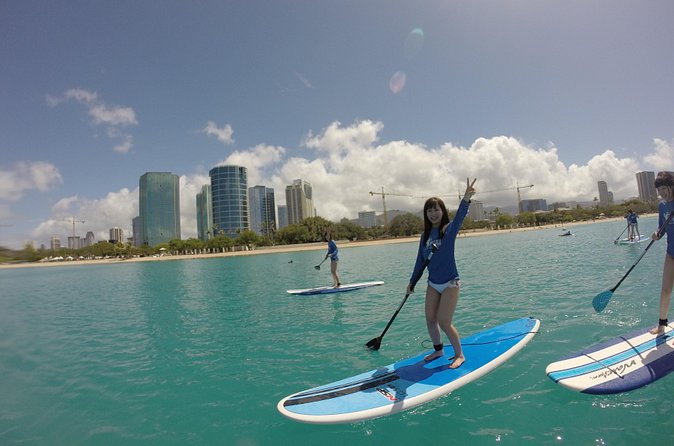
The first minutes on a paddleboard are usually about finding a stable stance. You need to balance your feet, keep your body relaxed, and avoid making every small wobble into a dramatic correction. That is easier when you have an instructor nearby rather than trying to figure it out alone.
The goal is not simply to remain standing. You learn to move the board where you want it to go. The paddle acts as your engine, brake, and steering tool, depending on how you use it. A good lesson helps you connect those movements instead of treating them as separate tricks.
The flat water at Ala Moana gives you room to build confidence. You can first get a feel for moving forward, then practice turning and adjusting to the current. If you fall, the activity is built around water practice, so getting back on is part of the learning process. The supplied leash is an important piece of safety gear because it keeps the board close if you lose your balance.
The experience includes an experienced lifeguard and CPR-certified instructors. That does not remove the need to listen carefully or follow safety directions, but it adds reassurance during a water activity. Life jackets are available as well, which may appeal to anyone who feels uneasy about stepping onto a board for the first time.
More Surf Lessons in Oahu:
- Open Group Surfing Lesson in Waikiki, Hawaii
★ 4.5 · 582 reviews - Oahu: Beginner-Friendly Waikiki Beach Surfing Lesson
★ 4.9 · 425 reviews - Surfing Lessons On Waikiki Beach
★ 4.5 · 317 reviews - Waikiki Private Group Surf Lesson
★ 5.0 · 298 reviews
When the lesson shifts from flat water to waves
You are not pushed straight into wave riding. The lesson first takes you onto flatter water, where you can work on balance and control. Once you feel confident, you can try riding waves if you are feeling ambitious.
That progression makes the activity suitable for more than one kind of participant. A cautious beginner can focus on standing, paddling, and turning without treating the lesson like a test. Someone who catches on quickly can ask for more challenge.
I would keep expectations realistic here. The main product is instruction, not a guaranteed wave-riding session. Conditions, comfort, and skill level will affect how far you go. The description promises the chance to ride waves after you feel ready, not a full surf lesson or a set number of wave rides.
The flat-water portion may be the most valuable part for a beginner. It gives you the base you need if you decide to rent a board later. Learning to control the board in calmer conditions is less exciting than chasing a wave, but it is far more useful than struggling without a plan.
What makes the small group size matter
With a maximum of four participants, this is a more personal lesson than a large beach class. You are not one face in a crowd waiting for the instructor to circle back. The instructor can watch your stance, notice problems with your paddle technique, and adjust the explanation.
You can choose a small-group or private lesson. A private session should suit you if you want the most direct attention or feel nervous about learning in front of others. A small group may be the better value if you like having other people around and want to keep the cost lower than a one-to-one session.
The coaching style matters as much as the group size. Nate is specifically praised for clear communication, patience, kindness, and helpful instruction adjusted to the student’s level of comfort. Those qualities are important in SUP because frustration can build quickly when the board will not cooperate.
The experience has a minimum age of 12. That makes it appropriate for older children and adults, though the activity data does not give a separate child price or specific youth equipment details. Service animals are allowed, and the site is near public transportation.
A close look at the included equipment
The $139 price includes the main gear you need to take the lesson. That means a paddleboard, paddle, leash, and reef shoes are provided. Rashguards and life jackets are available, which may reduce the amount of equipment you need to pack.
You should still arrive prepared for a beach activity. Bring a swimsuit, towel, and sunblock, since those are not included. Food and drinks are also not part of the price, so plan those separately if you expect to be out for a while.
I appreciate the reef shoes in particular. The information does not promise a specific entry surface or say that every participant will need them, but foot protection can be useful around a beach environment. It is one less piece of water gear you need to arrange yourself.
The mobile ticket is convenient for a phone-based booking. Confirmation is provided at the time of booking, so you should have the activity details available when arranging your day.
Is $139 a fair price for two hours?
At $139 per person, this is not the budget choice for getting on a paddleboard. If you already know how to SUP and only want time on the water, a basic rental may offer better value.
The price makes more sense if you are paying for instruction rather than just equipment. You get an approximately two-hour experience, an instructor, board and paddle, leash, reef shoes, available safety gear, and potentially round-trip pickup from a selected Waikiki hotel. A group capped at four also gives you more access to the instructor than a busy class.
The lesson is especially useful if you have wanted to try SUP but have kept putting it off because you did not know how to begin. The dry-land demonstration, calm starting area, and coaching on turns and currents reduce the guesswork.
I would book it for a first experience, a private lesson, or a small group that values coaching. I would think twice if your main goal is simply to spend a little time on a board and you are comfortable teaching yourself.
The small details that can shape your day
The activity is scheduled for about two hours, though the lesson options are described as one or two hours. Check the specific option you select when booking, since that affects how much time you will have for instruction and practice.
You can book about five days ahead on average, but I would not treat that as a guarantee of same-week availability. Morning and afternoon options help, yet the small four-person limit means popular times may fill sooner than a large group activity.
Cancellation is flexible if you act early. You can cancel at least 24 hours before the local start time for a full refund. Cancellations or changes made inside that 24-hour window are not accepted for a refund.
The experience is intended for most participants, but you should still consider your own comfort in the water and ability to balance on a moving board. The supplied information does not provide a detailed fitness standard, so ask Surf HNL if you have a specific concern before booking.
Who will get the most from Surf HNL
I would recommend this lesson to a first-time paddleboarder who wants clear instruction rather than a quick rental. It also suits someone who has tried SUP before but wants help with turning, steering, reading the current, or staying upright.
It is a good fit for a small family group with participants aged 12 or older, a couple wanting a shared activity, or a solo visitor who prefers a structured lesson. The private option is worth considering if you want the instructor to focus closely on your technique.
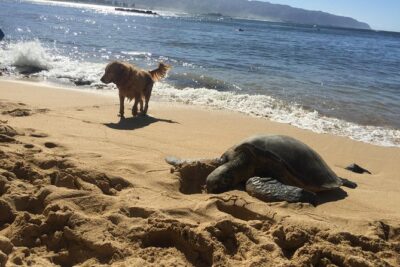
The activity may not suit you if you dislike water sports, want a full day on the beach, or expect a guaranteed sea turtle sighting or wave session. A turtle was seen during one experience, but that is a fortunate possibility, not part of the promised schedule.
The strongest reasons to book are practical: small groups, patient instruction, calm starting water, and gear supplied. Those details give you a real chance to leave with a new skill instead of simply checking SUP off your list.
Should you book this Ala Moana SUP lesson?
Book Surf HNL if you want to learn stand-up paddleboarding in a calm setting with close coaching. The dry-land practice, small maximum group size, selected Waikiki pickup, and included gear make the $139 fee easier to justify for beginners.
Skip it if you only want the cheapest possible board time or already feel confident on a SUP. For everyone else, this is a focused two-hour introduction with room to progress from basic balance to flat-water paddling and, if conditions and confidence allow, waves.
FAQ
Where does the stand-up paddleboard lesson take place?
The lesson takes place at Ala Moana Beach Park in Honolulu. The stated meeting point is 71 Ala Moana Park Drive, Honolulu, HI 96815.
How long does the experience last?
The experience lasts approximately two hours. The activity also describes one-hour and two-hour lesson options, so check the specific option selected at booking.
What time of day can I take the lesson?
You can choose from morning or afternoon time slots, subject to availability.
Is hotel pickup included?
Round-trip pickup is included from selected Waikiki hotels only. If your hotel is not one of the selected properties, meet at the Ala Moana location.
How many people can join the lesson?
The maximum group size is four participants. You can choose a small-group or private lesson.
What equipment is included?
The experience includes a stand-up paddleboard, paddle, leash, and reef shoes. Rashguards and life jackets are available.
What should I bring?
Bring your own towel, swimsuit, and sunblock. Food and drinks are not included.
What is the minimum age?
The minimum age is 12 years.
Can I cancel for a full refund?
Yes. You can cancel at least 24 hours before the local start time for a full refund. Cancellations or changes made less than 24 hours before the start time are not accepted for a refund.
Just added for surfers in Oahu
- Semi-Private Surfing Lesson in Waikiki, Oahu★ 5.0 · 26 reviews
- Waikiki 2 Hours Private Guided Surf Lesson★ 3.5 · 8 reviews
- Surf Lessons on the North Shore Great for Families and all Ages★ 5.0 · 27 reviews
- Surf Activity on the Wai Kai Wave in Ewa Beach★ 5.0 · 8 reviews
- Learn to surf with a local big wave rider on the North Shore of Oahu★ 4.5 · 10 reviews
- Private Group Surf Lesson★ 5.0 · 47 reviews
- Semi-Private Surf Lesson★ 5.0 · 17 reviews
- Group Surf Lesson: Two Hours Of Beginners Instruction★ 5.0 · 32 reviews
Oahu Surf Lessons, compared.
Beginner-Friendly Waikiki Beach Surfing Lesson
Read our review →
Family, Private & Group Surfing Lessons, Waikiki Courtesy Shuttle
Read our review →
Browse the lists this tour appears in